

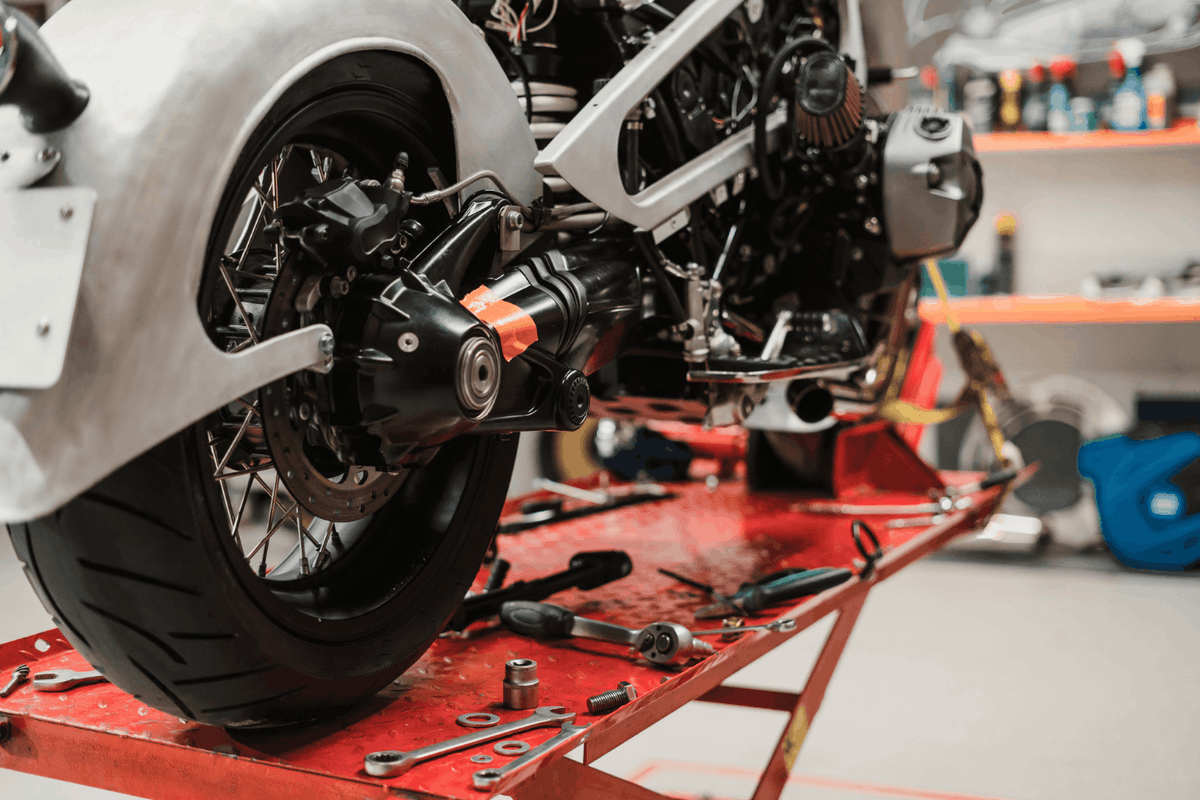
Bottom line: a motorcycle lift is not a car lift scaled down. The bike cannot stand up on its own, so the front wheel vise and your tie-downs are doing as much work as the hydraulics. Size the lift by two numbers, the wet weight of your heaviest bike plus a margin, and the deck length against your wheelbase. Almost everything else is preference.
For most home garages a 1,000 to 1,200 lb air or electric table is the right call. Full-dress touring bikes, trikes, and shops running bikes all day are the reason 2,000 lb-plus benches exist. Here is how to pick between them, and how to use one without dropping a motorcycle.
Quick Navigation
- The Short Answer
- Lift Table vs Jack vs Stand
- How to Use a Motorcycle Lift Safely
- What Capacity Do You Actually Need?
- Deck Length, Width, and Your Garage
- Air vs Electric-Hydraulic
- The Features That Earn Their Keep
- ATVs, UTVs, and Trikes
- Our Picks at Three Capacities
- Frequently Asked Questions
- Take the Next Step
The Short Answer
- Sport bikes, dirt bikes, standards, most cruisers. A 1,000 lb table is plenty. These bikes run 400 to 600 lb wet and you are nowhere near the limit.
- Full-dress touring bikes and heavy cruisers. Step up to 1,200 lb or better. A loaded bagger can run 850 to 950 lb wet, which puts a 1,000 lb table uncomfortably close to its rating.
- Trikes, ATVs, and shop use. 2,000 lb or more, and pay attention to deck width as much as capacity. Trikes and quads are wide before they are heavy.
Rule of thumb: leave at least 25 percent headroom over your heaviest bike's wet weight. Ratings are for a static, centered load, and you will be pushing and pulling on that bike while it sits up there.
Lift Table vs Jack vs Stand
Three different tools that people shop as if they were one. They solve different problems.
Paddock and swingarm stands
$50 to $200. They lift one wheel a few inches for chain maintenance, tire removal, or winter storage. Cheap, light, and genuinely useful. They do not raise the bike to working height and they do not help your back.
Motorcycle jacks
$150 to $500. A scissor jack that lifts the bike under the frame, usually to 12 to 16 inches. Good for oil changes and quick jobs, stores under a bench, and works on a garage floor without a dedicated bay. The limitation is stability: the bike is balanced on a narrow pad, and there is no platform under your feet or your tools.
Lift tables
$1,000 and up. A full platform the bike rides onto up a ramp, then rises to standing or seated working height. The bike sits on its own wheels on a stable deck, clamped in a front wheel vise. This is the tool if you actually work on bikes rather than occasionally maintain one.
Take-away: if your ceiling on spend is a few hundred dollars, buy a jack and good stands. Do not buy a cheap table. The failure mode on an underbuilt table is a bike on its side, and that is a $3,000 mistake on a $900 saving.
How to Use a Motorcycle Lift Safely
The sequence matters more than the equipment. Most drops happen during loading and unloading, not while the bike is in the air.
- Set the lift on level ground and check the ramp seat. The ramp should sit flat and square against the deck. Any rock in the ramp becomes a lurch when the front wheel crosses it.
- Walk the bike up, do not ride it up. Engine off, in gear or with the front brake covered, and take it slow. A second person steadying the rear is worth having the first few times.
- Seat the front wheel in the vise and clamp it. The vise holds the bike upright. It is not optional and it is not a substitute for straps.
- Strap it down anyway. Two tie-downs minimum, pulling forward and down against the vise so the front suspension is slightly compressed. The straps stop the bike moving when you lean on it, not just when it is being lifted.
- Raise in stages and engage the safety lock. Take it up, let it settle onto the mechanical lock, and confirm the lock is engaged before you put a hand on the bike. The hydraulics hold the load; the lock is what catches it if they do not.
- Watch what you remove. Pulling a wheel, a fork, or an engine changes the balance of a bike that is only being held by its front wheel. Support the frame before you take a wheel off.
- Lower deliberately. Raise slightly off the lock first, release it, then lower. Do not unstrap until the deck is all the way down.
Red flags: a bike that rocks when you push on the seat, a vise that will not fully clamp your front tire width, straps run to bars or plastic instead of triple clamps or frame, and working on a lift that is not sitting on its safety lock. Any one of those and stop.
What Capacity Do You Actually Need?
Capacity is the easiest spec to get right and the one people most often cut too close.
Start with wet weight, not dry weight. Manufacturers publish both, and dry weight excludes fuel, oil, and coolant. A full tank alone is 30 to 40 pounds. Then add anything permanently bolted on: hard bags, a trunk, a fairing, crash bars, a sidecar.
| Bike type | Typical wet weight | Minimum lift |
|---|---|---|
| Dirt bike, dual sport | 250 to 350 lb | 1,000 lb |
| Sport bike, standard | 400 to 500 lb | 1,000 lb |
| Mid-size cruiser | 550 to 700 lb | 1,000 lb |
| Full-dress tourer, bagger | 850 to 950 lb | 1,200 lb+ |
| Trike, ATV | 900 to 1,300 lb | 2,000 lb+ |
These are ranges, not gospel. Look up your specific model. But the pattern holds: one bike category is the reason 1,000 lb tables come up short, and it is the full-dress tourer.
Deck Length, Width, and Your Garage
Capacity gets the attention. Dimensions are what actually bite you.
Deck length against wheelbase. A typical table deck runs 84 to 89 inches. Touring bikes push 65 to 67 inches of wheelbase, and once you add the front tire ahead of the axle and the rear behind it, a long bike eats most of an 84 inch deck. You want the whole bike on the platform with the front tire fully seated in the vise, not hanging past the end.
Overall length with the ramp down. This is the number people forget. A lift with an 84 inch deck can need 106 to 116 inches of clear floor with the ramp extended. Measure the run in front of the lift, not just the lift.

Width and side access. Decks run roughly 24 to 32 inches. Narrow is fine for bikes and gives you better access to both sides. Wide is what you need for ATVs and trikes, or you are buying side extensions later.
Lowered height. Six to seven inches is typical. Lower is better, because it flattens the ramp angle and makes loading a low bike less of an event.
Lift height. 30 inches gets you to comfortable seated work. Low 40s gets you to standing work, which is the difference between a good afternoon and a sore back. If you are choosing between two otherwise equal lifts, take the taller one.
Concrete. Manufacturers specify a minimum 4 inches of concrete for these lifts. Verify your slab before you order, not after it ships.
READY TO SHOP?
Browse the full motorcycle and powersports lift lineup at Pitstop Pro. Capacity, deck length, and lowered height published on every model so you can measure before you order.
Shop motorcycle liftsAir vs Electric-Hydraulic
Two power options, and the right one depends on what is already in your garage.
Air operated lifts run off shop air, typically in the 90 to 100 PSI range. No electrical work, fewer parts to fail, and usually a lower purchase price and lighter unit. The catch is obvious: you need a compressor that can actually supply it. If you do not have one, add its cost to the lift's.
Electric-hydraulic lifts plug into a standard 110V outlet and are self-contained. No compressor, no air line across the floor, and generally faster and smoother under load. They cost more and add a power unit to maintain.
Take-away: already have a decent compressor, buy air and save the money. No compressor, buy electric rather than buying a compressor to feed a lift.
The Features That Earn Their Keep
- Front wheel vise. Non-negotiable. Check that it adjusts to your tire width, because a vise that will not close on a narrow front tire is useless.
- Drop panel or rear cutout. A removable rear section so you can pull the rear wheel, service the brake, or change a tire without the deck in the way. If you do your own tires, this is the feature to insist on.
- Mechanical safety lock with multiple positions. More lock positions means you can set a comfortable working height rather than the nearest one.
- Ramp design. Full-width and retractable beats a narrow bolt-on. Retractable ramps also give you back floor space when the lift is down.
- Tie-down points. Look for proper anchor points on the deck. Strapping to whatever you can reach is how people bend things.

Worth skipping unless you have a specific reason: air-over-hydraulic on a lift you will raise twice a month, and anything sold on deck finish rather than deck size. Browse the full motorcycle lifts collection → with capacity and deck dimensions listed on every model.
ATVs, UTVs, and Trikes
A motorcycle lift will handle an ATV only if you have bought for it deliberately.
Width is the constraint, not weight. A quad is 46 to 50 inches across. A 24 to 30 inch motorcycle deck does not cover that, so you need side extensions or a purpose-built ATV bench. Many motorcycle lifts offer extension kits, and they are the cheap way to make one lift do both jobs if your ATV work is occasional.
UTVs are a different machine entirely. Side-by-sides run well past 1,500 lb and are far too wide for any motorcycle table. That is a dedicated UTV lift → or a frame lift, not an extension kit.
Trikes need width and capacity. Both rear wheels have to sit on something, and a trike conversion adds significant weight over the base bike. Check the rear track width against the deck plus extensions before assuming it fits.
Our Top Picks
Here are the standouts from this category, picked by our Lift Specialists for real-world fit and value.

Tuxedo M-1000C: 1,000 lb Air Table (Home Garage Pick)
💳 Affirm & Shop Pay Installments at checkout | $1,150
The right answer for most home garages. 1,000 lb capacity on shop air at 90 to 100 PSI, so there is no electrical work to do if you already run a compressor. The deck is 84 by 24 inches, drops to 7 inches for an easy ramp angle, and rises to 30 inches for comfortable seated work. Front wheel vise and a rear drop panel come standard, which means you can pull a rear wheel without fighting the platform. Side and front extensions plus a cycle jack are available if your needs grow.
Best for: Sport bikes, standards, and cruisers in a garage that already has air.
View Pricing & Specs →★★★★★ Verified reviews · Authorized dealer · Lift Specialists ready to help

AMGO MC-1200: 1,200 lb Electric-Hydraulic (Best for Baggers)
💳 Affirm & Shop Pay Installments at checkout | $1,350
The step up that full-dress touring bikes actually need, and it is self-contained: a 1.0 HP 110V single-phase power unit, no compressor required. 1,200 lb capacity with an 88-9/16 inch runway that swallows a long wheelbase, a 6-1/8 inch lowered height, and 42-15/16 inches of lift so you can work standing rather than stooped. 23 second rise time. AMGO backs it with 5 years on the steel structure, 3 on hydraulics, and 2 on electrical and other parts.
Best for: Baggers and heavy cruisers, and anyone without shop air who wants standing-height work.
View Pricing & Specs →★★★★★ Verified reviews · Authorized dealer · Lift Specialists ready to help

iDEAL M-2200IEH-XR: 2,200 lb Pro Bench (Shop Pick)
💳 Affirm & Shop Pay Installments at checkout | $3,390
A shop bench rather than a home table. 2,200 lb capacity on an 88-5/8 by 31.5 inch platform, 7 inch minimum height, and 47-1/4 inches of maximum lift, which is genuine standing-height work on the heaviest touring bikes and trikes. Six locking positions with magnetic release let you set the height you want instead of the nearest one, and the full-width retractable ramp gives back floor space when the lift is down. Single-point handheld remote pendant, 30 second rise and lower.
Best for: Shops running bikes daily, plus trikes and full-dress tourers that need width and height.
View Pricing & Specs →★★★★★ Verified reviews · Authorized dealer · Lift Specialists ready to help
Frequently Asked Questions
How do you use a motorcycle lift?
Set the lift on level ground, seat the ramp squarely, and walk the bike up with the engine off rather than riding it on. Clamp the front wheel in the vise, then add at least two tie-downs pulling forward and down so the front suspension is slightly compressed. Raise the lift, let it settle onto the mechanical safety lock, and confirm the lock is engaged before you touch the bike. Lower by lifting slightly off the lock, releasing it, then descending, and leave the straps on until the deck is fully down.
What size motorcycle lift do I need?
Take your heaviest bike's wet weight and add at least 25 percent. Most bikes are covered by a 1,000 lb table, but a full-dress touring bike at 850 to 950 lb wet needs 1,200 lb or better. Then check deck length against your wheelbase, because a long touring bike will use nearly all of an 84 inch platform.
Do I need to bolt a motorcycle lift to the floor?
Follow the manufacturer's instructions for the specific model, since some are designed as free-standing and others are not. What is consistent across these lifts is the concrete requirement: manufacturers specify a minimum of 4 inches of concrete. Verify your slab thickness before ordering rather than after the lift arrives.
Is a motorcycle lift table better than a jack?
For real work, yes. A table puts the bike on its own wheels on a stable platform at working height, and gives you somewhere to stand and set tools. A jack balances the bike on a narrow pad under the frame, which is fine for an oil change and unnerving for anything longer. The jack wins only on price and storage.
Can I use a motorcycle lift for an ATV?
Only with side extensions or a purpose-built ATV bench. An ATV is 46 to 50 inches wide and a motorcycle deck is typically 24 to 32 inches, so the wheels hang off without extensions. Weight is usually not the problem; width is. Many motorcycle lifts offer extension kits, which is the economical route if ATV work is occasional rather than routine.
Air or electric, which is better for a motorcycle lift?
Whichever matches your garage. Air-operated lifts need a compressor supplying roughly 90 to 100 PSI, cost less, and have fewer components to fail. Electric-hydraulic lifts run off a standard 110V outlet and are self-contained. If you already own a capable compressor, air is the better value. If you do not, buy electric rather than buying a compressor just to run a lift.
How high should a motorcycle lift go?
Around 30 inches puts the bike at comfortable seated working height. Lifts reaching into the low 40s let you work standing, which matters a lot over a long job. Between two otherwise comparable lifts, the taller one is the better buy because you can always work at a lower height but you cannot exceed the maximum.
Do I still need tie-downs if the lift has a front wheel vise?
Yes. The vise holds the bike upright and locates the front wheel, but it does not stop the bike shifting when you lean into it, pull a wheel, or torque a fastener. Use at least two straps pulling forward and down against the vise. Run them to the triple clamps or frame, never to handlebars, mirrors, or plastic.
Take the Next Step
Before you order, write down three numbers: your heaviest bike's wet weight, its wheelbase, and the clear floor length you have available with a ramp extended. Those three decide the lift. Everything else on the spec sheet is preference.
If you want a second opinion, call our Lift Specialists at (470) 208-2754 or email support@pitstop-pro.com with your bike and your bay dimensions. We will tell you honestly whether the cheaper table covers you.
Keep Reading
Ready to buy?
Shop motorcycle lifts at Pitstop Pro
We carry Tuxedo, AMGO, Atlas, and iDEAL motorcycle and powersports lifts from 1,000 lb home tables up to 2,200 lb shop benches. Send a Lift Specialist your bike and your bay dimensions and we will tell you what fits.
Shop motorcycle liftsTalk to a Lift SpecialistLifetime customer support and a free fitment consult before you order. No sales tax in most states.
Leave a comment