
Skip to content

2 Post Car Lifts

2 Post Car Lifts For Sale

2 Post Car Lifts For Sale: Home Garages & Pro Shops

Shop two post car lifts for sale from 6 authorized brands: AMGO, Atlas, Triumph, Tuxedo, Katool, and iDEAL. Capacities from 9,000 lb to 20,000 lb. Clear-floor, overhead, symmetric, and asymmetric configurations. ALI ETL certified models for pro shops. 42 pickup locations nationwide.

42Pickup Locations
6 BRANDSIn Stock
9K – 20KLb Capacity

Filters


About 2 Post Lifts

Two post car lifts for sale, from 9,000 to 20,000 lb

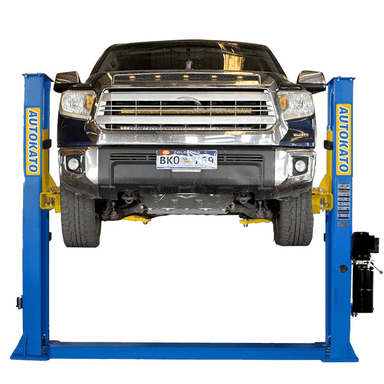
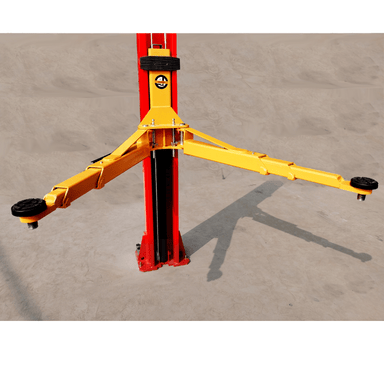
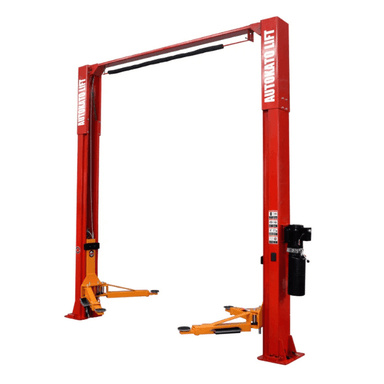
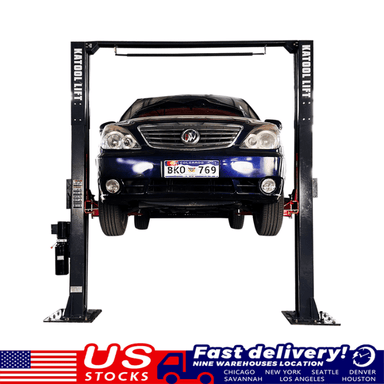
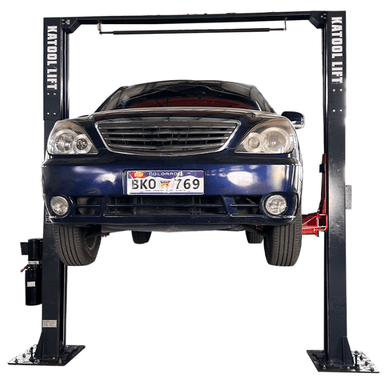
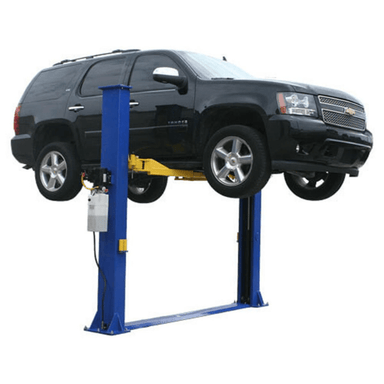
A two post car lift is the standard pro-shop service lift. Two vertical posts on either side of the vehicle, four arms that swing under the chassis to grab the factory pinch-welds, and a hydraulic mechanism that pulls the entire vehicle into the air with the wheels hanging free. That free-wheel access is the whole point. Brakes, exhaust, suspension, drivetrain, tires, axles, transmissions, fuel tanks: every service that needs the wheels off becomes a stand-up job at chest height.

Pitstop Pro stocks 61 two post car lifts for sale from 6 authorized brands (AMGO, Atlas, Triumph, Tuxedo, Katool, and iDEAL) in 9,000 lb (entry/home garage), 10,000 lb, 11,000 lb (the sweet spot), 12,000 lb, 14,000 lb, 15,000 lb, 16,000 lb, 18,000 lb, and 20,000 lb (heavy-duty commercial truck) configurations. Clear-floor, overhead, symmetric, and asymmetric arm styles all available. ALI ETL certified options for commercial shops where code compliance and insurance matter.

Not sure which two post car lift fits your bay? Use our Lift Finder for a sizing recommendation based on your vehicle weight, ceiling height, and garage width. Or call (470) 208-2754 for a real lift specialist.

Browsing 2-post lifts. See also all vehicle lifts, 4-post lifts, scissor lifts, and alignment lifts.


Collection page image for two post car lifts

Why buy a 2 post car lift?

Four reasons two post lifts have been the pro-shop standard for forty years.

Wheels hang free

The reason a 2-post exists. Wheels off the platform means every brake, suspension, exhaust, and drivetrain job becomes a 30-minute stand-up service instead of a 2-hour back-breaker.

Compact footprint

Two posts and an overhead bar (or a base plate). Takes up roughly the footprint of a single parked car. A 2-post lift fits in most two-car garages without losing the second bay.

$

Best value per lift

The cheapest type of car lift dollar-for-pound of capacity. A 9,000 lb 2-post starts around $1,899. A 4-post storage lift starts around $2,699. A scissor or alignment lift, $2,599 and up.

Standard for pro shops

Every commercial service bay in North America runs a 2-post. ALI ETL certified models meet ANSI/ALI ALCTV safety code, OSHA, and insurance requirements for commercial use.

Shop two post car lifts by capacity

Match capacity to the heaviest vehicle you will lift, with at least 15-20% safety margin. A modern F-150 routinely curbs at 5,000-5,500 lb loaded, so 9K minimum for half-tons.

Clear-floor vs Overhead: which 2-post should you buy?

After capacity, this is the #2 decision in 2-post lift shopping. Both work the same way. Different placement of the safety cables.

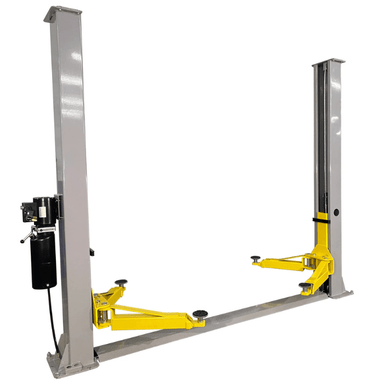
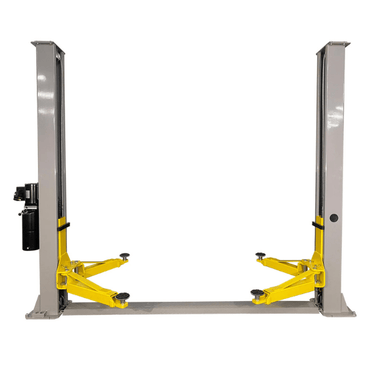
Clear-Floor / Floor Plate

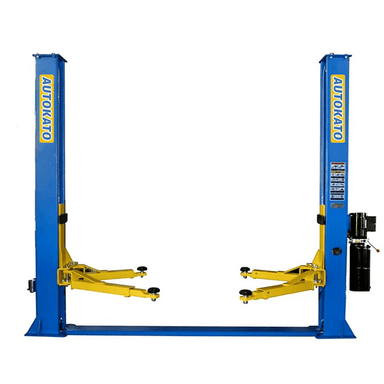
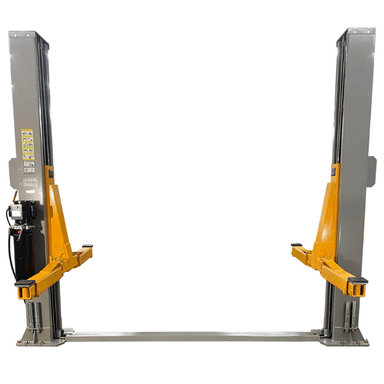
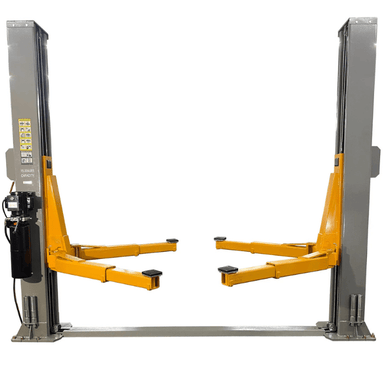
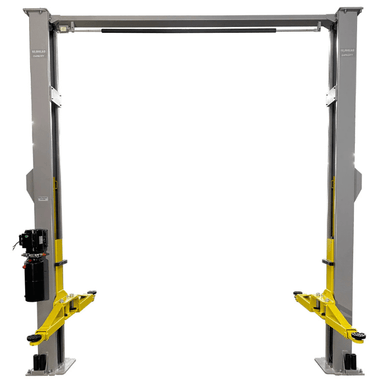
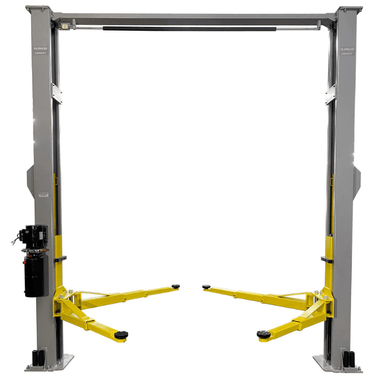
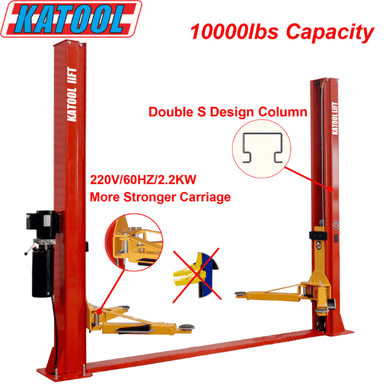
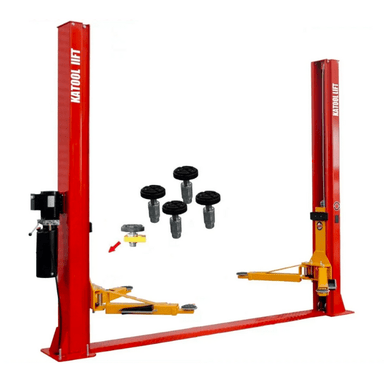
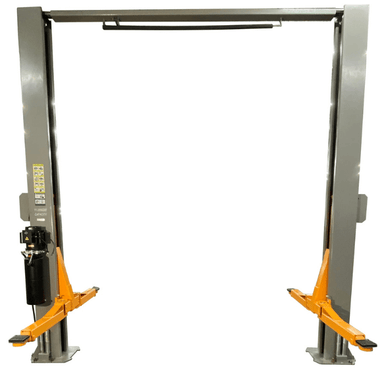
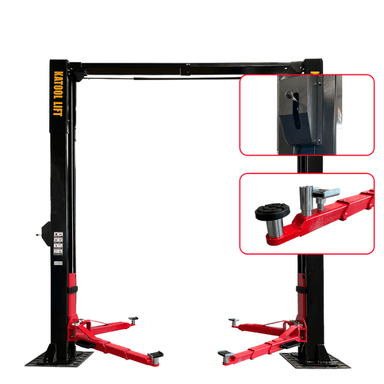
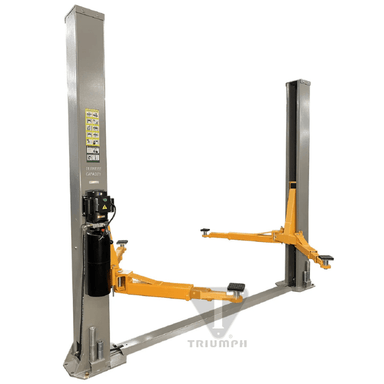
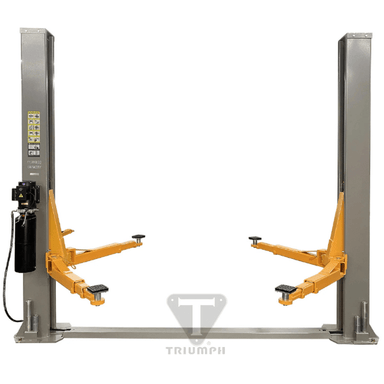
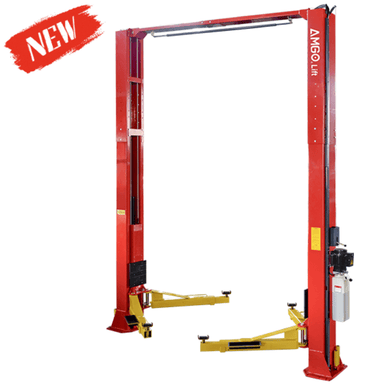
Clear-Floor 2-Post Lift

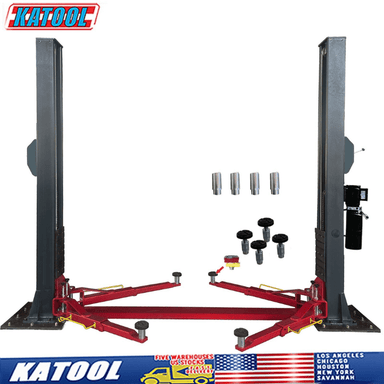
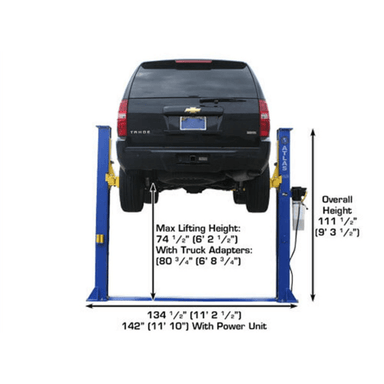
  • Safety cables run through a steel plate on the floor between the posts.
  • Nothing overhead, so very tall vehicles (crew-cab pickups, lifted SUVs, ambulances) fit without hood clearance issues.
  • Tripping hazard: the floor plate sits proud of the concrete by ~3 inches.
  • Higher overhead lift height than overhead-style at the same total post height.
Best for: Garages with low ceilings (under 11 ft), or shops that lift crew-cab trucks, lifted SUVs, and oversized vehicles.
Overhead

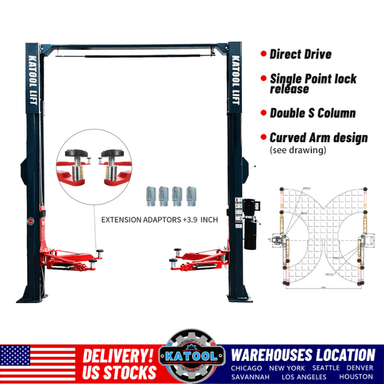
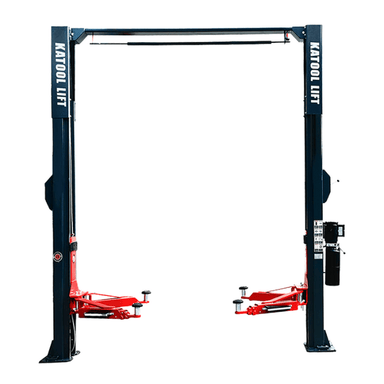
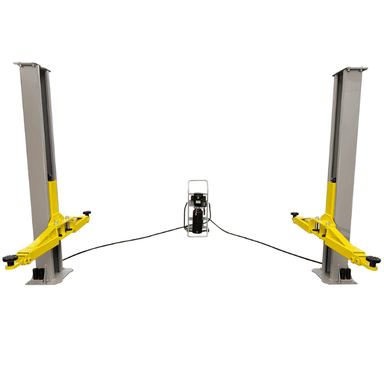
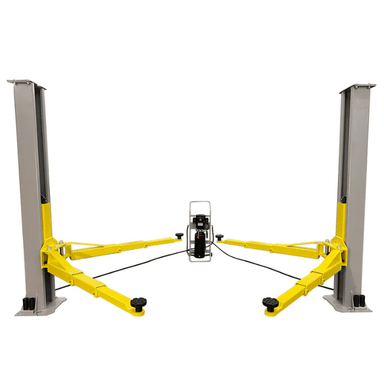
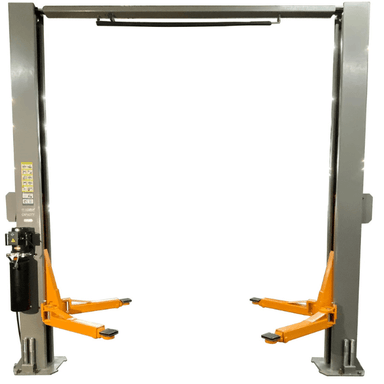
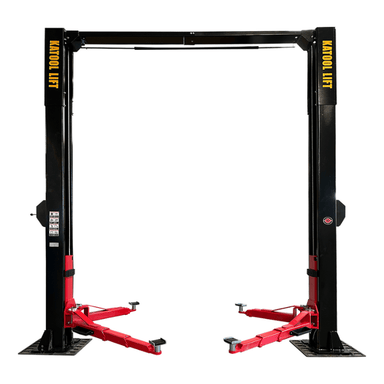
Overhead 2-Post Lift

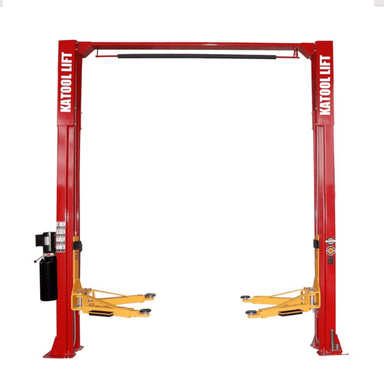
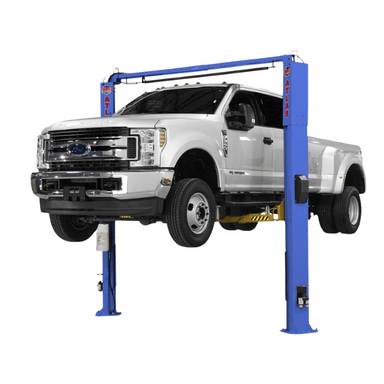
  • Safety cables run across a beam at the top of the two posts.
  • Clean floor between posts: no tripping hazard, easier sweep-up.
  • Max vehicle height is constrained by the overhead bar (typically 12-13 ft of ceiling needed for full-rise).
  • Industry-standard look for commercial service bays.
Best for: Garages with 12+ ft ceilings and pro shops where the visual cleanliness of an unobstructed floor matters.

Doing the research first?

Read our 2-post buying guides before you choose.

2 Post Car Lift FAQs

The most common questions our lift specialists get specifically about two post car lifts.

What capacity 2 post lift do I need?

Pick capacity to match the heaviest vehicle you will lift, plus 15-20% margin. Quick guide for 2-post lifts specifically: 9,000 lb covers sedans, sports cars, small SUVs, and compact pickups (Civic, Corolla, Miata, RAV4, Ranger). 10,000-11,000 lb covers half-ton pickups (F-150, Silverado 1500), full-size SUVs, and most modern crossovers. 12,000-14,000 lb covers 3/4-ton pickups (F-250, Silverado 2500), large SUVs, and heavy work vans. 15,000-16,000 lb covers 1-ton dually trucks (F-350, Silverado 3500), RVs, and light commercial. 18,000-20,000 lb covers medium-duty service trucks, shop trucks, and commercial vans where the lift sees daily duty cycles.

Do not undersize. A modern F-150 routinely curbs at 5,000-5,500 lb loaded with passengers and cargo. A 9K lift only has ~3,500 lb of margin in that case, which is borderline for safety.

Clear-floor vs overhead 2 post lift: which is better?

Neither is better. They solve different problems. Both lift the same way (cables run through pulleys to a hydraulic ram), they just route the cables differently.

Clear-floor (also called floor-plate) routes the safety cables through a steel plate on the ground between the posts. Pros: no overhead obstruction, so lifted trucks and tall vehicles do not contact a bar. Cons: the floor plate sits proud of the concrete by ~3 inches, which is a tripping hazard and harder to sweep.

Overhead routes the cables across a beam at the top of the posts. Pros: clean unobstructed floor. Cons: the overhead bar limits maximum lift height by 6-12 inches and you need 12+ ft of ceiling for full-rise.

Pick clear-floor if your ceiling is under 11 ft, you lift tall trucks regularly, or you hate floor obstructions. Pick overhead if you have plenty of ceiling and want the cleanest-looking pro-shop floor.

Symmetric vs asymmetric arms: what's the difference?

Symmetric 2-post lifts have arms of equal length, with the vehicle centered between the posts. Pros: simpler design, slightly cheaper, easier to lift trucks and vans (their long wheelbases work fine centered).

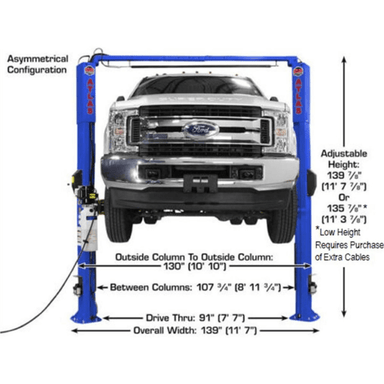
Asymmetric 2-post lifts have arms of different lengths (longer in the rear, shorter in the front), or the posts rotated to allow the cabin doors to swing open without hitting the posts. Pros: car doors open fully when lifted, the driver can get into the cabin to release a parking brake or move a transmission selector while the car is on the lift. Cons: smaller capacity vehicles preferred, marginally more expensive.

For a service shop with mixed vehicles: asymmetric is the standard pick. For a home garage lifting one or two cars you know well: symmetric is simpler and cheaper.

How much ceiling height do I need for a 2 post lift?

Most 2-post lifts need 11-12 ft of ceiling to reach full lift height. Overhead-style lifts need slightly more headroom than clear-floor because the overhead bar takes up vertical space.

If your ceiling is between 9-11 ft, look for low-ceiling clear-floor 2-post lifts: their posts are slightly shorter and they reach a slightly lower max lift height, but they still get vehicles 5-6 ft off the ground for full service access.

If your ceiling is under 9 ft, a 2-post is probably not the right choice. Look at mid-rise scissor lifts which fit under 8 ft ceilings.

What concrete slab thickness for a 2 post lift?

Industry minimum is 4 in of 3,000+ PSI concrete for 2-post lifts up to 11,000 lb. For 12,000-20,000 lb lifts, specs typically require 6 in of 3,000+ PSI concrete.

Slab thickness matters more for 2-post than 4-post because all of the lift's load is transferred into the concrete through anchor bolts at the post bases. If anchors pull out, the post tips. Old, cracked, or thin slabs are the #1 cause of 2-post installation problems.

If your slab is unknown or older than 10 years, do a core sample before installing. Adding a thicker concrete pad in the lift area is a one-day project for a contractor and worth the peace of mind.

Can I install a 2 post lift myself?

Yes, with caveats. 2-post lifts can be DIY-installed by handy homeowners, but the install is more involved than a 4-post and the consequences of bad anchoring are bigger. Plan a long weekend with at least one helper. You will need: a confirmed slab thickness, a rotary hammer drill, a torque wrench, chemical or wedge concrete anchors rated for the lift, and a chain hoist or engine hoist to raise the posts.

Most DIYers who have read the manual carefully and prepared the slab properly install successfully. If you are unsure, professional installation typically runs $400-800 in most metros. Some manufacturers require professional install for warranty on heavier commercial lifts (15K+).

Call (470) 208-2754 for install quotes in your area.

What electrical do I need for a 2 post lift?

Most home-grade 2-post lifts up to 11K capacity run on 220V single-phase (the same circuit as an electric dryer, NEMA 6-20 or 6-30 plug). Most newer garages have at least one 220V outlet available; if not, an electrician can run one in a day for $300-600.

Commercial 2-post lifts 12K+ often offer both 220V single-phase and 220V/440V three-phase motor options. Three-phase service is typically only available in commercial and industrial buildings.

110V is not a realistic option for 2-post lifts: the motor draws too much amperage. If 220V is not an option at your bay, talk to us before ordering at (470) 208-2754.

ALI ETL certified vs non-certified: do I need certified?

The Automotive Lift Institute (ALI) is the industry safety body. ALI ETL certified lifts have been third-party tested by Intertek to meet the ANSI/ALI ALCTV safety standard.

Required for: Commercial shops in most US states, commercial insurance compliance, and any shop offering alignment work to retail customers.

Optional for: Home garage use. Most homeowners insurance does not require ALI certification, though some carriers may offer a discount for certified lifts.

If you are running a pro shop: buy ALI ETL. Atlas and AMGO have full ALI-certified 2-post lineups. If you are a home enthusiast on a budget: non-certified lifts from reputable brands (Triumph, Katool) are widely used and meet equivalent capacity ratings.

Single-point vs dual-point lock release: what is it?

This refers to how the lift's mechanical safety locks release when you lower the vehicle. Each post has a ratcheting safety latch that engages every few inches as the car goes up; before you can lower, the latches have to be released.

Dual-point means you walk to one post, pull a release lever, then walk to the other post and pull a second release lever, then lower. Safe, simple, two-step operation.

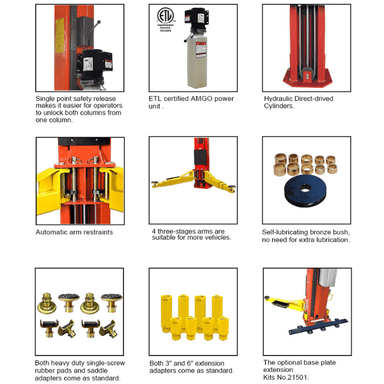
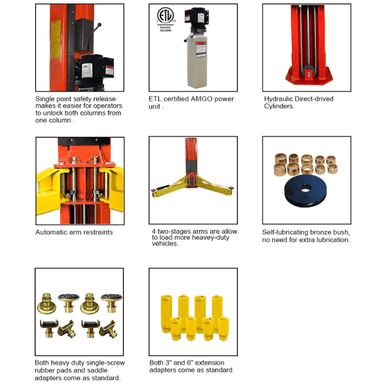
Single-point means a single lever (or push-button on premium models) releases both post locks simultaneously. Faster operation, often preferred by busy shops. Slightly more expensive.

For home use either works. For a shop doing 20+ lifts a day, single-point saves real time.

How long do 2 post car lifts last?

A properly installed and maintained 2-post lift will last 20-30+ years in home garage use. Pro shops running 10-20 lifts a day commonly get 15-25 years before retirement.

Wear items that may need replacement over the lift's life: hydraulic cylinder seals (5-10 years), safety cables (10-15 years), arm bushings (10+ years), hydraulic fluid (annually). Powder-coated steel posts and welded structure typically outlast the lift's useful service life.

Annual ALI inspection is recommended (and required for commercial use). Annual hydraulic fluid change and bolt-torque check is the minimum maintenance to hit those lifespan numbers.

How long is shipping on a 2 post car lift?

Most in-stock 2-post lifts ship within 2-5 business days from our Georgia warehouses or one of our 42 pickup locations. Freight transit time depends on distance, usually 3-7 business days to the contiguous US. Total order-to-doorstep is typically 1-2 weeks.

Pickup is available at our warehouses for customers who want to grab their lift the same week and save on freight.

What's the warranty on a 2 post lift?

Warranties vary by brand. AMGO: 5 years structural, 2 years hydraulic, 1 year wear. Atlas: 2 years parts and labor on most Platinum lifts. Triumph: 5 years structural, 1 year wear. Tuxedo: 2-5 years structural depending on model. Katool: 1-2 years parts on most models.

All warranties are direct from manufacturer. Pitstop Pro handles claims as the authorized dealer, so you do not need to contact the manufacturer separately if something needs warranty service.