

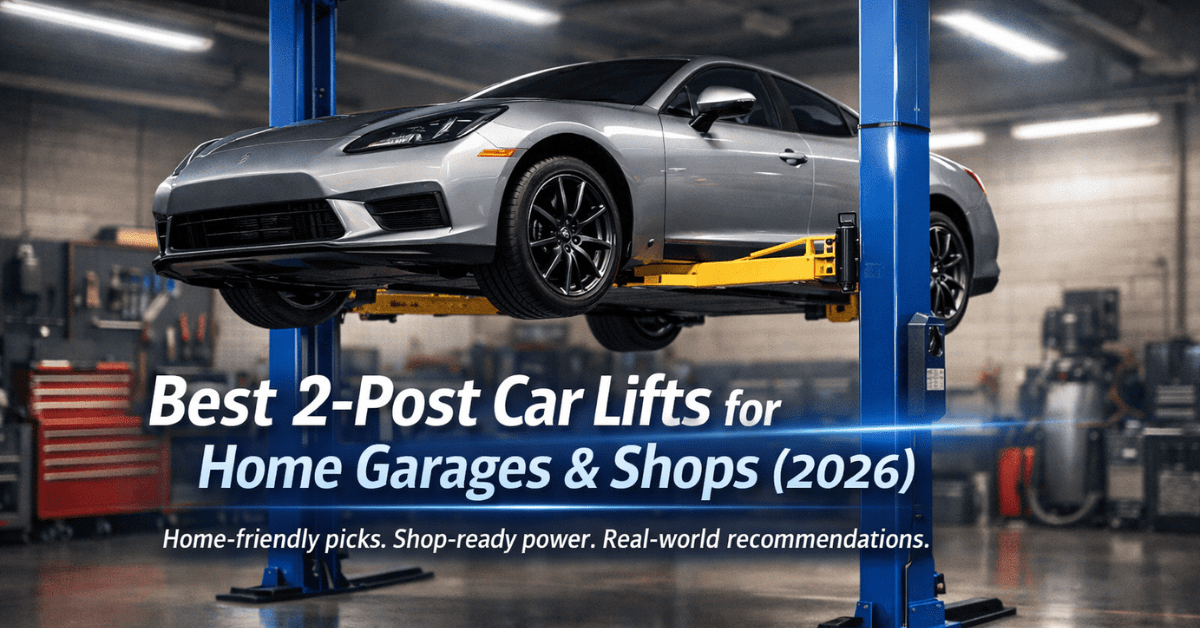
Looking for the best 2 post car lift for your garage? Two-post auto lifts are the workhorses of any serious garage, perfect for wheels-off repairs like brake jobs and suspension work. Before you pick one, you’ll need to check your ceiling height and concrete slab – those installation details matter.
In this guide, we’ll explain how 2-post lifts work and where they shine, share fast fitment tips, highlight handpicked 2-post lift models for home garages and busy shops, and help you decide whether a 2-post is the right lift for you.
Quick Navigation
What Is a 2-Post Auto Lift & Why Choose One?
A 2-post vehicle lift uses two upright columns and four adjustable arms to engage the manufacturer’s lift points on the chassis. Because the car is supported by its frame, the wheels hang free—perfect for brakes, suspension, tires, and under-car service. Compared with a drive-on (4-post) lift, a 2-post takes far less floor space while giving unobstructed access to the underside.
For many small shops and home garages, that combo—compact footprint plus wheels-free access—makes a 2-post the go-to “work” lift. It’s generally more affordable than a comparable 4-post, quicker to set up for repairs, and easier to fit in a single bay. If your priority is service (not long-term storage), a good 2-post is tough to beat.
Why choose a 2-post:
-
Wheels-free by design for brakes, hubs, struts, control arms, and tire work.
-
Small footprint—easier to fit in tight bays than most 4-posts.
-
Great under-car access (exhaust, driveline, fluid service, fabrications).
-
Typically lower cost than 4-post units of similar capacity.
-
Fast workflow once you get the hang of spotting lift points.
When a 4-post might be better:
-
Storage/stacking a second car, or frequent drive-on inspections.
-
Very low ceilings where a low-rise or mid-rise lift fits better.
-
Heavy, long-wheelbase rigs where drive-on stability is preferred.

Pros and Cons of 2-Post Lifts
Every lift type has trade-offs, and 2-posts shine for repair work while 4-posts and scissor lifts suit other jobs. Below is a quick, skimmable comparison to help you match a lift to your space and use case. The best choice is the one that fits your vehicles, ceiling, slab, and workflow.
Why Mechanics Like 2-Posts (Pros)
2-post car lifts prioritize access and efficiency in tight shops. With the chassis supported at four pads, the center is wide open and the posts don’t eat floor space. Many models include adapters for low cars and taller trucks, so one lift can cover a broad vehicle mix.
-
Full undercar access: Wheels hang free for brakes, suspension, exhaust, tire rotations, and oil service.
-
Space-saving footprint: Narrow posts fit tighter bays, and you can park between them when the lift is down.
-
Cost-effective ownership: Fewer materials and simpler maintenance deliver pro capability on a budget.
Where 2-Posts Fall Short (Cons)
2-posts ask more from your building and your technique than drive-on styles. They rely on a spec-compliant concrete slab and accurate vehicle positioning on every lift cycle. Some users also prefer the visual solidity and storage convenience of a 4-post until they’ve built confidence with a 2-post.
-
Installation requirements: Correct concrete thickness/PSI and proper anchoring are non-negotiable; budget for a pad if your slab is light.
-
Positioning effort: Align arms to OEM lift points each time and do a quick low-height “shake test.”
-
Not ideal for storage: Fine for short stints, but long-term parking is easier and simpler on a 4-post →.
-
Overhead constraints: Clear-floor models need taller ceilings; watch door tracks, openers, and lights, while floorplate versions trade a little rise to fit low ceilings.
Bottom Line
For most repair and maintenance tasks, the pros—full access, smaller footprint, and lower cost—outweigh the drawbacks. If you meet install specs and follow proper operating procedure, a quality two-post lift is safe, fast, and versatile. Choose based on your heaviest vehicle, ceiling height, and how you’ll use the lift day to day, and if you’re unsure which model best fits your setup, our team at Pitstop Pro is here to help.

NEED A 2-POST LIFT?
Browse 2-post car lifts at Pitstop Pro. Top brands, fitment reviewed before you order, and Lift Specialists who help you size capacity and slab fit.
Shop 2-post liftsProduct Highlights: Best 2-Post Lift Picks for Home Garages
Home Garage Picks
What Home Garages Typically Need in a 2-Post Lift
For home garages and hobby shops, the sweet spot is strong lifting power without turning your bay into a permanent construction project. The best 2 post lifts for home use prioritize a space-friendly footprint, realistic ceiling fitment, and simple operation you can trust on weekends. If you’re tight on space, pay extra attention to portability, slab requirements, and how easily you can get proper lift points under your vehicles.
-
Home garages prioritize: Space efficiency, straightforward operation, and safe lock engagement
-
Fit matters most at home: Ceiling height, door tracks/openers, and proper lift-point access
-
Install reality check: Concrete thickness/PSI and electrical capacity (110V vs 220V)
Katool 10,000 lb Two-Post Car Lift | KT-H105

Katool KT-H105: 10,000 lb 2-Post (Budget Pick)
Katool's volume 2-post. 10,000 lb capacity, symmetric design, dual-cylinder hydraulic. The strongest entry-tier value in the 2-post category.
Best for: Budget-focused buyers who still want 10K capacity and basic safety features.
View Pricing & Specs →★★★★★ Verified reviews · Authorized dealer · Lift Specialists ready to help
AMGO 9,000 lb Two-Post Lift | BP-9

AMGO BP-9: 9,000 lb 2-Post (Mid-Tier Pick)
Solid mid-tier 2-post. 9,000 lb capacity, symmetric design, single-point safety release. Best-selling AMGO 2-post for home garages and light shops.
Best for: Home garages with 11-foot+ ceilings looking for a step up from import budget brands.
View Pricing & Specs →★★★★★ Verified reviews · Authorized dealer · Lift Specialists ready to help
Want more 9,000 and 10,000 lb options? Compare every model in our 9,000 to 10,000 lb 2-post lifts →
Triumph 7,000 lb Portable Two Post Auto Lift | C-7000
This is the go-to pick when you want real wheels-off service without committing to a permanent install. It’s designed for tight garages or rental situations where flexibility matters, but you still want a true 2-post style lift experience. Follow the concrete floor specs and always lower onto the mechanical locks at your working height before you get underneath.
-
Capacity: 7,000 lb
-
Best for: Tight garages, rentals, and anyone who wants flexibility
-
Real-world benefit: Wheels-off access without a permanent footprint
-
Safety habit: Always work on the mechanical locks, not just hydraulics
-
Install check: Confirm concrete requirements before setup

Katool 11,000 lb Two-Post Vehicle Lift | H115Z
The H115Z is a strong step up from entry-level capacity, making it a better match for trucks and heavier SUVs while still keeping the footprint value-friendly. It’s a practical home-garage lift when your vehicle mix includes bigger daily drivers and you don’t want to feel like you’re near the limit. Plan on using pad adapters for frames and pinch-welds, and verify ceiling height and slab PSI before you install.
-
Capacity: 11,000 lb
-
Best for: Trucks and heavier SUVs in a home garage
-
Real-world benefit: More margin for heavier vehicles without going “shop-only”
-
Setup tip: Use pad adapters for safe contact on frames and pinch-welds
-
Fit checks: Ceiling height + slab PSI requirements

Katool 12,000 lb Two-Post Car Lift (Single Lock Release) | H120D
If you want extra capacity for a mixed home fleet, the H120D delivers with simple day-to-day operation and a single lock release setup. The big thing to watch at home is vertical clearance since the taller columns can conflict with door tracks and openers if your garage is tight.
-
Capacity: 12,000 lb
-
Best for: Mixed home fleets and heavier vehicles with room to spare
-
Real-world benefit: Extra capacity with straightforward daily use
-
Fit checks: Tall column clearance under door tracks/openers

Working on 3/4-ton and 1-ton trucks? See our heavy-duty truck lifts (12,000 lb+) →
Optional Accessories → to Consider for 2-Posts
Outfitting your two-post lift with the right accessories can make it safer and more versatile:
-
Frame Cradle Adapters: Useful for boxed truck frames and SUVs, these cradle the frame securely (great for lifting pickups without slipping).
-
Pinch-Weld Pads: Slip-on pads that protect unibody pinch welds at factory jack points, preventing metal-on-metal damage.
-
Height Extension Kits: Provide extra lifting height for vehicles with lifts or oversized tires, while keeping the arms in a safe working range.
-
Screw-Up Pad Sets and Rubber Pads: Allow fine-tuning of lift pad height and add a cushioned, non-slip contact to protect vehicle undercarriages.
-
Anchor Bolt Kits & Column Extensions: If allowed by the manufacturer, you can extend column height or relocate anchors – always use new anchor bolts (never reuse old anchors) and follow the manual strictly for any modifications.
Shop pads, adapters and extension kits in our 2-post lift accessories →
Fitment, Height, Install, and Safety Essentials for 2-Post Lifts
Baseplate vs. Overhead
If you’re deciding between baseplate vs overhead 2-post lifts, start with your ceiling height and how you work in the bay. Floor-plate (baseplate) lifts are a smart pick for low-ceiling garages because there’s no top crossbar to worry about. Overhead clear-floor designs keep the floor free of a center hump, which is ideal for rolling transmission jacks, toolboxes, and creepers under the vehicle.
-
Baseplate benefits: Better for low ceilings, no overhead crossbar to clear
-
Overhead benefits: Clear floor for transmission jacks and smoother shop workflow
-
Practical tip: Think about what you roll under the car every day
Symmetric vs. Asymmetric Arms
With symmetric vs asymmetric 2-post designs, the difference is mostly about vehicle positioning and door clearance. Symmetric lifts keep the vehicle centered between the posts, which is often a better match for trucks and evenly distributed loads. Asymmetric lifts offset the vehicle for better door opening clearance, and many modern lifts use 3-stage arms to reach a wide range of lift points across different vehicles.
-
Symmetric: Centered positioning, great for trucks and heavier vehicles
-
Asymmetric: Easier door clearance, faster in tight bays
-
Modern advantage: 3-stage arms help cover more lift points across more vehicles
Ceiling Height and Door Hardware
Always measure the usable height under door openers, ceiling tracks, lights, and anything hanging overhead. The top of the columns has to clear your door hardware, and tight clearances can limit how high you can safely lift. If your ceiling is low, consider short-column models or a high-lift garage door conversion to reroute the tracks higher.
-
Measure first: Opener height, tracks, lights, and any obstructions
-
If height is tight: Short-column lifts or high-lift door conversion can solve it
-
Real-world goal: Full lifting height without hitting door hardware
Concrete and Power Requirements
Every 2-post lift has concrete requirements, typically a minimum slab thickness (often about 4 to 6 inches) and concrete strength (usually 3,000+ PSI), so confirm your slab meets the manufacturer specs before drilling. Power matters too, since some lifts run 110V while many higher-capacity models need a dedicated 220V circuit with the correct breaker size (and shops may see single-phase or three-phase needs). Use fresh anchors, torque them to spec, re-torque after a few cycles, and for two-post lift safety always lower the vehicle onto the mechanical locks before working underneath.
-
Concrete baseline: Commonly 4 to 6 inches thick and 3,000+ PSI (verify your lift’s manual)
-
Electrical check: 110V vs 220V, single-phase vs three-phase, breaker sizing
-
Install best practice: Use new anchors, torque to spec, re-torque after initial cycles
-
Safety non-negotiable: Work on mechanical locks, not hydraulics
Who Should Buy a 2-Post Lift? (Use Cases & Misconceptions)
If you work on vehicles regularly, a 2-post lift is often the best mix of access, speed, and price. It’s the default choice for repair-centric garages because the wheels hang free and the center stays wide open. The key is matching the lift to your ceiling height, slab strength, and vehicle mix.
Home Garage DIYers
A mid-range 9k–10k lb 2-post turns brake jobs, suspension work, and oil changes into comfortable, safe, stand-up tasks. You’ll gain dealership-style access without sacrificing much floor space. Confirm ceiling height and concrete specs first, and you’ll wonder how you lived without it.
-
Daily-driver friendly: Pad heights that reach OEM lift points on sedans, SUVs, and light trucks.
-
Small-space win: Narrow posts; you can park between them when the lift’s down.
-
Setup reality: Plan for 220V power and a slab that meets thickness/PSI requirements.
Independent Mechanics & Small Shops
For general repair, one or two 2-posts form the backbone of a productive shop. Pick capacity for your heaviest vehicle, not your average ticket. Train techs on positioning and lock use, and you’ll get speed without compromising safety.
-
Why shops choose 2-post →: Total undercar access, fast wheel-off work, and top versatility per dollar.
-
Certification advantage: ALI-certified → models help with inspectors, insurers, and standardized safety practices.
-
Throughput boost: Quicker tire/brake/suspension cycles keep bays turning and revenue flowing.
Frequent Undercar Repairs
Exhaust, suspension, and tire services favor wheel-free lifting. Off-road shops swapping lift kits and big tires especially benefit from free-hanging wheels and clear access to control arms and shocks. Mobile techs can’t bring a 2-post, but any fixed location chasing undercar work should.
-
Wheel-off by design: Makes rotations, hub/bearing, and brake jobs faster.
-
Adapter ready: Truck adapters/height extensions help span frame rails and tall ride heights.
-
Repeatable setup: Consistent arm reach to OEM points = fewer surprises.
When Not to Buy a 2-Post (Good Alternatives)
If your goal is long-term storage, a 4-post is simpler and more forgiving. Very low ceilings are workable with baseplate designs, but you’ll sacrifice some rise. For big trucks or fleet rigs, spec capacity with margin and verify slab requirements up front.
-
Storage first? Choose a 4-post for stacking/long-term parking and everyday “drive on, drive off” convenience.
-
Very low ceilings (< ~9 ft)? Consider baseplate two-posts or low ceiling lifts to fit the space.
-
Extra-heavy vehicles (> ~15k lbs): Look at 18k two-posts, mobile column lifts, or specialty heavy equipment.
Common Misconceptions, Fixed
-
“2-posts are unsafe for trucks/SUVs.” Reality: Properly rated, correctly positioned symmetric/versymmetric lifts handle trucks daily; the margin and adapters matter most.
-
“Only a pro can install one.” Reality: Many handy owners DIY with the right tools and a helper; pros are still smart if you’re unsure—plumb, square, and torque to spec.
-
“They tip over easily.” Reality: Modern lifts, anchored to a compliant slab with locks engaged and weight centered, are engineered for stability far beyond rated load.
-
“Low garage means no 2-post.” Reality: Baseplate models and shorter columns can fit 8–9 ft ceilings; you’ll trade a bit of max rise but still gain huge service access.
Bottom line: If repairs and maintenance are your main game, a 2-post is the right tool for speed and access. Match capacity to your heaviest rig, confirm ceiling/concrete/power, and follow the manual. Do that, and you’ll safely lift everything from Miatas to pickups with confidence — and if you’d like expert guidance on choosing the right model, reach out to us anytime at support@pitstop-pro.com or 470-208-2754.
Conclusion and Next Steps
Choosing the right two-post car lift comes down to matching the lift to your use case and your space. Start with what fits your ceiling height and layout, then narrow it down by capacity and arm style based on the vehicles you’ll lift most often. A low-ceiling home garage usually makes more sense with a baseplate 2-post, while a commercial shop typically gets the most utility from a high-clearance, high-capacity overhead model.
-
Quick next step: Pick the lift style (baseplate vs overhead), confirm ceiling and concrete specs, then dial in capacity and arm design
-
Pro tip: Plan your adapter kits up front so you can lift trucks, SUVs, and pinch-weld vehicles correctly from day one
Shop 2-Post Lifts →: Browse our full selection of two-post lifts to compare specs, pricing, and availability.
Add Adapter Kits →: Explore frame cradle pads, height extension adapters, and other 2-post accessories to match your vehicle lineup.
Talk to a Lift Specialist: Get a free fit check, install guidance, or the nearest warehouse with your lift in stock so you can buy with confidence.
Additional Resources
-
The Ultimate 2-Post Car Lift Guide – In-depth guide on installation, safety, and choosing the right two-post lift.
-
Symmetric vs. Asymmetric Lifts – Detailed comparison of lift styles and how to pick the right configuration.
-
OSHA/ALI Safety Standards – Overview of OSHA’s requirements and the Automotive Lift Institute’s safety guidelines for operating lifts.
Keep Reading
Ready to buy?
Find the right 2-post lift at Pitstop Pro
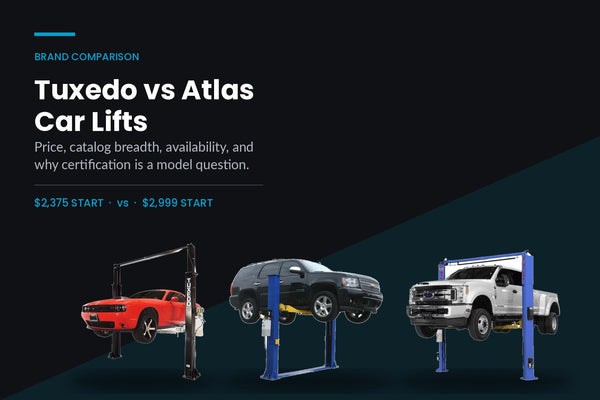
We carry 2-post lifts from Atlas, AMGO, Tuxedo, Triumph, Katool, and more. Talk to a Lift Specialist or browse the full collection to find the right capacity, ceiling fit, and concrete spec for your garage.
Shop 2-post liftsTalk to a Lift SpecialistLifetime customer support and a free fitment consult before you order. No sales tax in most states.
Leave a comment