

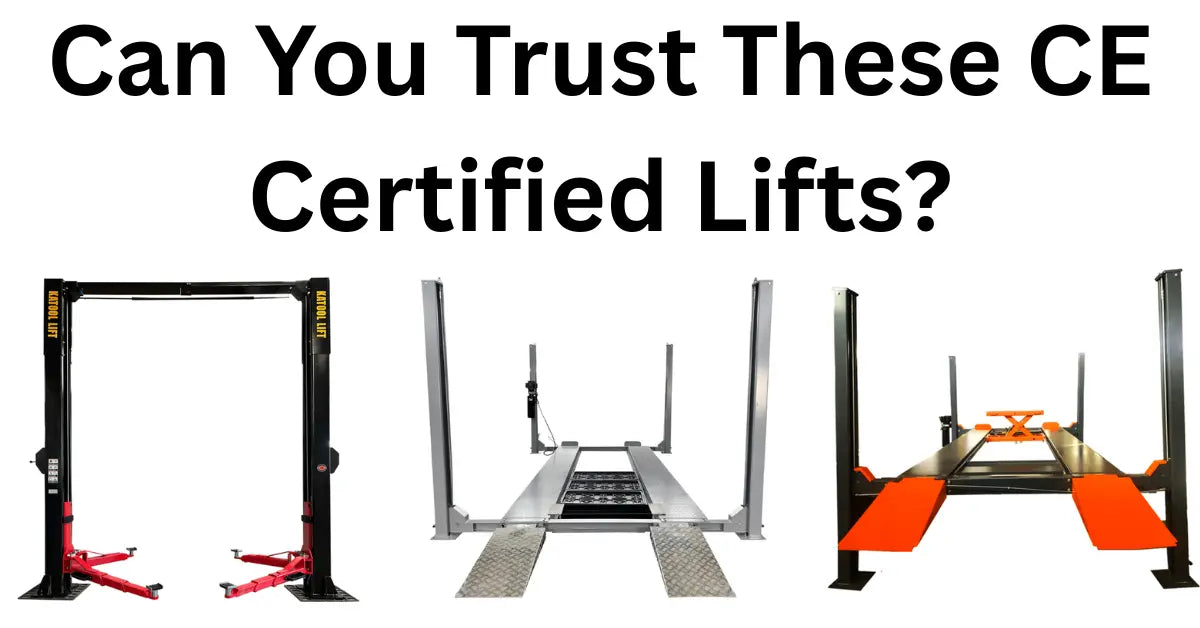
Confused about the “CE” mark on a car lift? You’re not alone. Many shoppers see a CE certified car lift and assume it’s similar to the ALI certification used in North America—but that’s not the case.
In this post, we’ll break down what CE certification → means for car lifts, how it compares to ALI’s gold label, and what you should know before choosing a lift for personal or commercial use. By the end, you’ll understand what CE certification actually guarantees (and what it doesn’t), whether CE-marked lifts are safe and legal to use in the U.S., and when they might make sense for your garage. Let’s dive in!
A CE-marked lift signals “European Conformity,” meaning the manufacturer attests the product meets EU safety, health, and environmental rules. For vehicle lifts, that usually means complying with the EU Machinery Directive 2006/42/EC plus the harmonized standard EN 1493. In short, it’s the stamp that allows legal sale and use across all EU member states.
Self-declaration process: The lift maker tests the product, compiles a technical file, and issues a Declaration of Conformity.
Notified Body review (sometimes): High-risk or complex lifts may require design validation by an EU-approved testing agency.
Legal must-have in Europe: No CE mark ➜ no market access.
A CE lift must pass baseline mechanical and electrical checks to confirm it’s safe when used as directed. Tests include dynamic over-load to 115 % and static load to 150 % of rated capacity. Electrical parts must follow EU Low Voltage and EMC directives for proper wiring, grounding, and interference control.
Mechanical locks & arm restraints
Hydraulic flow restrictors to prevent free-fall
Emergency stop & clear labeling in the user’s language
CE relies on the manufacturer’s declaration that the lift meets EN 1493 and related directives. ALI (North America’s gold label) requires third-party testing by an NRTL to ANSI/ALI ALCTV, plus quarterly factory audits. Both aim at safe lifts, but ALI adds an independent layer of verification and U.S.–specific electrical checks (UL 201, NEC).
CE ≈ Baseline safety for EU markets—manufacturer tested, legally compliant.
ALI = Independent lab validation—preferred or mandated in U.S./Canada.
Choose CE for cost-effective, legally compliant lifts in DIY or European settings; choose ALI when North American codes, insurers, or high-volume usage demand extra assurance.
Want a deeper dive into how CE and ALI stack up?
Check out our full comparison guide: ALI vs CE Certification: What’s the Difference & Which to Trust? — where we break down the testing process, label enforcement, safety standards, and real-world use cases side by side.

A CE mark shows a lift complies with European standards—but North American rules are different. In a home garage, you can legally install and safely use a CE lift if it’s well-built, anchored to a 4-in./3 000 PSI slab, and wired correctly. In commercial bays, most inspectors, insurers, and building codes demand an ALI-certified (ANSI/ALI ALCTV) lift, so a CE-only unit risks a “red tag” shutdown.
Legal status: No federal law blocks CE lifts for private garages.
Cost benefit: Often $1,000+ cheaper than ALI-certified options like our 2-post car lifts →.
Safety key: Proper install—torqued anchors, balanced loads, monthly checks.
A CE lift works just like any other on the shop floor, but inspectors look for the ALI gold label as proof of ANSI compliance. Without it, you could fail a permit inspection, face OSHA scrutiny, or lose insurance coverage.
IBC adoption: 47 U.S. states require lifts to meet ANSI/ALI standards.
Liability risk: Non-ALI lifts can void insurance after an accident.
Future cost: Retrofitting UL-listed motors or replacing the lift later often erases upfront savings.
Many CE lifts share frames, cylinders, and locks with their ALI siblings—minus third-party testing. The trade-off is trust: you rely on the maker’s quality control and must handle any NEC/UL electrical tweaks yourself.
Structural parity: EN 1493 requires 115 % dynamic & 150 % static overload tests.
Electrical tweaks: Swap to UL-listed disconnects or U.S.-voltage motors if needed.
Brand vetting: Choose reputable manufacturers with clear documentation.
Go CE for budget-friendly, personal garages where no inspector will visit—especially with space-saving options like our 4-post car lifts →.
Go ALI for any workplace with employees, customers, or regular safety audits.
Either way, a lift’s real safety comes down to solid concrete, correct wiring, and disciplined maintenance—stick to those, and you’ll lift with confidence.

READY TO BUY?
Browse all vehicle lifts at Pitstop Pro. 2-post, 4-post, scissor, and alignment options from top brands, with Lift Specialists ready to help you choose.
Shop vehicle liftsCE-marked lifts can be a smart, budget-friendly choice—if you know their strengths and limits. Below you’ll find the key advantages, drawbacks, and buyer checkpoints in an easy-scan format.
Lower Price Point
CE lifts skip third-party ALI testing, so manufacturers pass the savings to you. A comparable CE two-post can cost hundreds—or even thousands—less than its ALI twin.
Solid Baseline Safety
True CE compliance (EN 1493) still demands 115 % dynamic and 150 % static overload tests, mechanical locks, and hydraulic fail-safes. When installed per the manual, these lifts safely handle their rated loads.
Broader Model Selection
Many global brands offer unique capacities, scissor styles, or space-saving footprints only in CE trim, giving hobbyists more choices to fit tight garages.
DIY-Friendly Features
CE lifts aimed at enthusiasts often ship in lighter, easier-to-handle pieces and include step-by-step install guides tailored to first-time owners.
No Independent Lab Stamp
The CE mark is a manufacturer’s promise, not a third-party verdict. You rely on the builder’s quality control instead of an NRTL stress test.
Limited U.S. Code Acceptance
Commercial inspectors, insurers, and OSHA typically require an ALI (ANSI/ALI ALCTV) label; a CE-only lift may be red-tagged in a pro shop.
Variable Support & Warranty
Import brands without a solid North-American distributor can leave you hunting for parts or service. Vet the seller’s reputation before buying.
Resale & Perception Hurdles
Savvy buyers know the difference; an uncertified unit may fetch less on the used market and won’t interest most commercial shops.
Clear Manufacturer Info – Look for a Declaration of Conformity and published specs; mystery brands are red flags.
U.S. Electrical Compatibility – Ensure the motor, plug, and disconnects meet UL/NEC requirements or budget for swaps.
Realistic Capacity Claims – Compare column size, steel thickness, and overall weight to similarly rated lifts; if it looks flimsy, it probably is.
Concrete & Install Quality – Use a 4-6 in., 3 000 PSI slab, torque anchors to spec, and level posts—poor installs, not the CE mark, cause most failures.
Bottom line: A CE-certified lift can be a safe, cost-effective upgrade for personal garages and low-risk environments—provided you verify the brand, follow install guidelines, and accept the responsibility of being your own quality inspector. Still Have Questions? Not sure if a CE-certified lift is right for your garage? Contact us for expert advice—we’re happy to help you find the safest, most cost-effective lift for your needs.
Here are the standouts from this category, picked by our Lift Specialists for real-world fit and value.

AMGO BP-9: 9,000 lb 2-Post (Top 2-Post Pick)
💳 Affirm & Shop Pay Installments at checkout | $2,335
Best-selling 2-post lift for home garages. 9,000 lb capacity, symmetric design, single-point safety release. AMGO's volume seller with US parts support.
Best for: Home garages with 11-foot+ ceilings working on cars and light trucks.
View Pricing & Specs →★★★★★ Verified reviews · Authorized dealer · Lift Specialists ready to help

Katool KT-4H110: 11,000 lb 4-Post (Top 4-Post Pick)
💳 Affirm & Shop Pay Installments at checkout | $3,299
Best-value 4-post in the lineup. True 11K capacity, free-standing install, 181.9-inch runway, drip trays included. Built for full-size trucks and SUVs.
Best for: Storage and service garages needing real 11K capacity at a mid-budget price point.
View Pricing & Specs →★★★★★ Verified reviews · Authorized dealer · Lift Specialists ready to help
Selecting between an ALI-certified and a CE-certified lift boils down to budget, risk comfort, and code requirements. CE lifts cover the European safety basics and shine for cost-conscious DIYers, while ALI lifts add third-party validation that satisfies North-American inspectors. Either way, the goal is a safe, rock-solid platform that lets you service vehicles with confidence.
CE Mark = Manufacturer Assurance – Meets EU Machinery Directive & EN 1493; great for home garages when installed correctly.
ALI Gold Label = Independent Lab Test – Validated to ANSI/ALI ALCTV; required in most U.S./Canadian commercial shops.
Your Call: Weigh cost savings vs. regulatory peace of mind, then match the lift to your workload.
Browse our Vehicle Lifts → – Compare capacities, certifications, and pricing in our curated collection.
Keep Reading The Pitstop Journal – Deep-dive article covers concrete specs, maintenance, buying tips, and more.
Our lift specialists love talking shop. Call, chat, or email for advice on model selection, freight quotes, or installation best practices. We’ll steer you toward the lift that fits today—and five years down the road.
📧 Email us anytime at support@pitstop-pro.com
📞 Call or text 470-208-2754
🔗 Contact us here and we’ll get back to you fast.
Bottom line: Whether you choose the value-driven CE route or the code-approved ALI path, a well-installed lift unlocks safer, faster wrenching. Explore our catalog, study the guides, and reach out anytime—you’ll be lifting smart in no time. 🚗🔧
Ready to buy?
We carry the full vehicle lift lineup: 2-post, 4-post, scissor, and alignment models from Atlas, AMGO, Tuxedo, Triumph, Katool, and more. Talk to a Lift Specialist or browse the catalog.
Shop all liftsTalk to a Lift SpecialistLifetime customer support and a free fitment consult before you order. No sales tax outside GA & IL.
Leave a comment