
Skip to content

Alignment Lifts

Alignment Lifts & Racks For Sale

Alignment Lifts & Racks For Sale: Pro Shop Ready

Shop alignment racks and alignment lifts for sale from 4 authorized brands: AMGO, Atlas, Katool, and iDEAL. Capacities from 12,000 lb to 18,000 lb. 4-post drive-on alignment racks and full-rise scissor alignment lifts. Most include rolling bridge jacks and turn-plate cutouts standard. ALI ETL certified options for shops requiring code-compliant alignment work. 42 pickup locations nationwide.

42Pickup Locations
4 BRANDSALI Options
12K – 18KLb Capacity

Filters

About Alignment Lifts

Alignment racks and alignment lifts for sale, built for pro shops

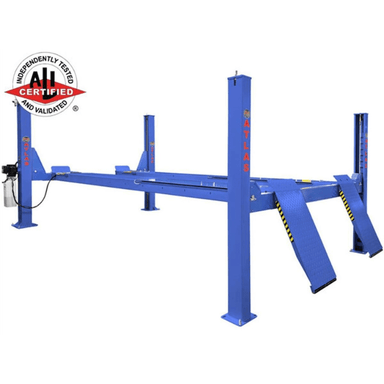
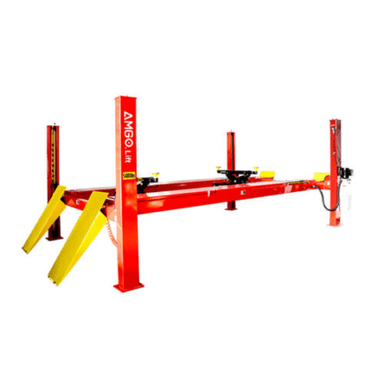
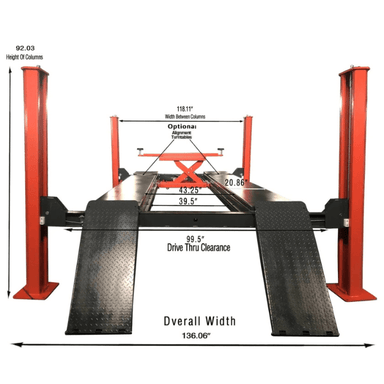
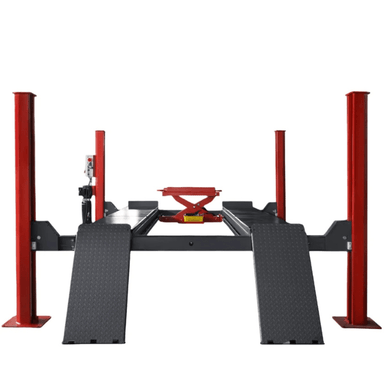
An alignment lift (also called an alignment rack) is a specialized vehicle lift engineered specifically for wheel-alignment service. It looks like a 4-post lift or scissor lift, but the runways are wider, longer, and built with turn-plate cutouts at the front and slip-plate recesses at the rear. A rolling bridge jack typically comes included or as an option. With the vehicle on the rack, all four wheels can be unweighted on turn-plates and slip-plates so a wheel-alignment machine can read camber, caster, and toe accurately.

If your shop offers wheel alignment as a service, you need a real alignment rack. A standard 4-post lift cannot perform alignment work because it lacks the turn-plate cutouts and proper geometry. Pitstop Pro stocks 13 alignment lifts and racks for sale from 4 authorized brands: AMGO, Atlas, Katool, and iDEAL. Capacities run 12,000 lb, 14,000 lb, 15,000 lb, 16,000 lb, and 18,000 lb. ALI ETL certified options for shops requiring code-compliant alignment work.

Not sure which alignment lift fits your shop? Call (470) 208-2754 for a real lift specialist who can match the rack to your vehicle mix.

Browsing alignment lifts. See also all vehicle lifts, 4-post lifts, scissor lifts, and wheel alignment machines.

Hero image for the alignment lifts collection page

Why buy a real alignment lift?

Four reasons a purpose-built alignment rack pays for itself in a pro shop offering alignment service.

Turn-plates & slip-plates built in

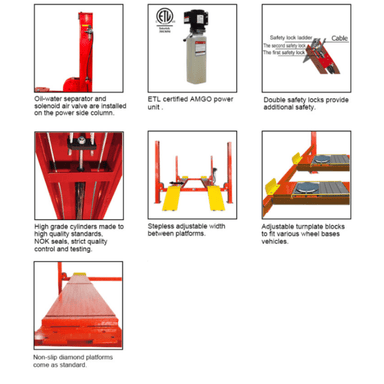
Front turn-plate cutouts let the steering wheels rotate freely while loaded. Rear slip-plate recesses let the rear wheels move under load. Required for accurate camber, caster, and toe readings.

Rolling jack ready

Wider runway spacing accommodates a rolling bridge jack. Lift wheels off the rack for tire rotation, brake service, or suspension work — alignment lift doubles as a service lift.

📏

Longer runways for trucks

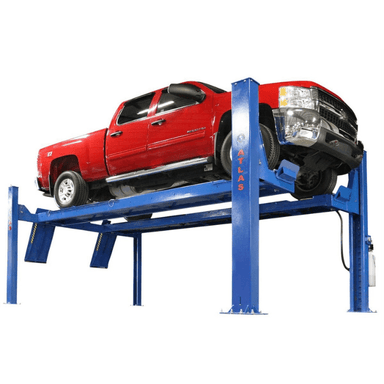
Extended runways fit full-size trucks, work vans, and dually rear ends. Standard 4-post lifts often clip front bumpers or leave rear axles overhanging. Alignment lifts are sized for service shop reality.

🛡

ALI ETL options

ALI-certified alignment lifts meet ANSI/ALI ALCTV safety code — required by most states for commercial alignment shops, and required for insurance compliance in alignment work.

4-Post vs Scissor Alignment Lift: which should you buy?

After capacity, this is the #1 alignment-rack decision. Both perform alignment work. They differ in footprint and ceiling needs.

4-Post Alignment

4-Post Alignment Lift

  • Drive-on alignment rack with 4 vertical posts and full runway support.
  • Lower price-per-capacity than scissor alignment lifts.
  • Wider stance accommodates full-size truck wheelbases comfortably.
  • Easier DIY install — typical 4-post rules apply (no concrete anchoring required for most home/light commercial installs).
  • Needs 11-12 ft of ceiling for full-rise.
Best for: Most pro alignment shops, dealerships, and any shop with 11+ ft ceilings. The category default — start here.
Scissor Alignment

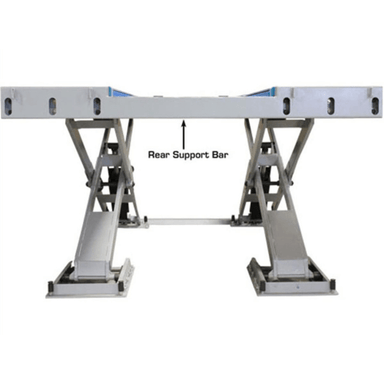
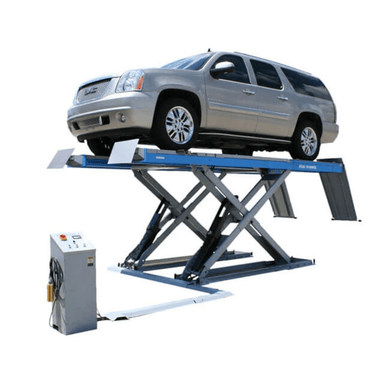
Scissor Alignment Lift

  • Full-rise scissor mechanism with no overhead structure.
  • Fits 9-10 ft ceilings where a 4-post alignment rack won't.
  • Flush-mount options sit into the floor for ground-level approach.
  • Higher price per capacity than 4-post.
  • ALI ETL certified models from Atlas and AMGO.
Best for: Body shops, multi-bay quick-lube/tire shops with low ceilings, or premium service centers where the clean flush-mount installation matters.

Doing the research first?

Read our buying guides before you pick an alignment rack.

Alignment Lift FAQs

The most common questions our lift specialists get specifically about alignment racks.

What's the difference between an alignment lift and a regular 4-post lift?

An alignment lift is a 4-post lift (or scissor lift) with specific geometry for wheel-alignment service. The key differences:

Turn-plate cutouts at the front: Recesses in the front of each runway hold turn-plates that let the steering wheels rotate freely under load. Without these, you can't measure caster.

Slip-plate recesses at the rear: Allow the rear wheels to move slightly when the vehicle is set on the lift, so the suspension settles into its loaded position. Without slip-plates, toe and camber readings are off.

Wider, longer runways: Built for trucks and full-size vehicles. Standard 4-post lifts clip bumpers or leave rear ends overhanging.

Rolling jack ready: Wider runway spacing accommodates a rolling bridge jack so you can lift wheels for tire and brake service while the vehicle stays in alignment position.

You cannot perform a real wheel alignment on a standard 4-post lift. If your shop offers alignment service, you need an alignment lift.

4-post vs scissor alignment lift: which should I buy?

4-post alignment lifts are the category default. Drive-on rack with four vertical posts, wider stance, lower price-per-capacity, and easier DIY install. Best for most pro alignment shops with 11+ ft ceilings.

Scissor alignment lifts use a full-rise scissor mechanism with no overhead structure. Higher price per capacity, but they fit in 9-10 ft ceiling bays where a 4-post won't, and flush-mount options sit into the floor for ground-level approach. Best for body shops, quick-service centers with low ceilings, and premium pro shops where the clean flush install matters.

If your bay has tall ceilings: start with 4-post. If your bay has low ceilings or you want flush-mount: scissor.

Do I need ALI ETL certification on an alignment lift?

Yes — almost certainly. ALI ETL certified lifts have been third-party tested by Intertek to meet the ANSI/ALI ALCTV safety standard. For commercial alignment service, ALI ETL is typically required by:

State and municipal codes: Most US states require ALI ETL for commercial vehicle lift use.

Commercial insurance: Insurance carriers almost universally require ALI ETL on commercial alignment lifts. Non-certified lifts may void coverage in the event of an accident or injury claim.

Manufacturer alignment systems: Many alignment-system manufacturers (Hunter, John Bean) require ALI-certified lifts for warranty.

For home or hobbyist alignment work, ALI certification is optional. For any shop charging customers for alignment service, buy ALI ETL. Atlas and AMGO have multiple ALI ETL alignment lifts in our catalog.

What capacity alignment lift do I need?

Match capacity to the heaviest vehicle you'll align, plus 15-20% margin. Quick guide:

12,000 lb: Sedans, SUVs, half-ton pickups (F-150, Silverado 1500), light-duty work vans. The minimum for a modern pro shop.

14,000-15,000 lb: 3/4-ton pickups (F-250, Silverado 2500), large SUVs (Suburban, Expedition), full-size work vans. The pro-shop sweet spot.

16,000-18,000 lb: 1-ton dually trucks (F-350, Silverado 3500), RVs, shop service trucks. Required if your shop aligns heavy work trucks daily.

If you're a new shop offering alignment service to passenger vehicles and light trucks: 12K is enough. If you're aligning trucks daily: don't undersize, go 14K minimum.

Does the alignment lift come with a rolling jack?

Varies by model. Katool KT-4H120X and KT-4H150 include the rolling jack standard. AMGO PRO series alignment lifts (PRO-12A, PRO-14A, PRO-18A) typically offer the rolling jack as an optional add-on at order time. Atlas PVL14OF-EXT sells the rolling jack separately. Check each product page for the specific bundle.

If your alignment lift doesn't include a rolling jack, you can add one from our Rolling Bridge Jacks collection. Most pro shops eventually want a jack so they can lift wheels for tire rotation, brake service, and suspension work without rolling the vehicle off the alignment rack.

What turn-plates do I need? Are they included?

Most alignment lifts have turn-plate cutouts in the runways but the turn-plates themselves are typically sold separately or as an add-on. Standard 8.5 in or 10 in turn-plates fit most alignment lift cutouts. We carry Katool turn-plates and AMGO turn-plates; both start around $149-$190 per pair.

Some premium alignment lift packages bundle turn-plates with the lift. Check the product page for the specific configuration.

What ceiling height do I need for an alignment lift?

4-post alignment lifts typically need 11-12 ft of ceiling for full-rise operation with a full-size truck on the rack. Scissor alignment lifts need 9-10 ft, which is the main reason to choose scissor.

For a 4-post alignment rack in a 10-11 ft ceiling bay, you can usually operate at less-than-full lift height for alignment work without issue — most alignment service doesn't require maximum lift height, just enough to fit underneath comfortably with the alignment camera or laser system.

What concrete slab do I need for an alignment lift?

Alignment lifts require 4-6 in of 3,000+ PSI concrete depending on capacity. 12K-14K alignment lifts typically need 4-5 in. 15K-18K alignment lifts often spec 6 in of higher-PSI concrete.

Critically, alignment lifts require a level slab — the runway-to-runway level affects alignment accuracy. Most manufacturers specify level within 1/4 in across the install footprint. If your slab is uneven, plan for shimming during installation. Some shops grind the slab flat for premium alignment installations.

Can I install an alignment lift myself?

Yes for 4-post alignment lifts, especially with one helper and a long weekend. Same install approach as a standard 4-post lift, but the runways are heavier and longer so a forklift or engine hoist is helpful. Plan extra time for level-checking and shimming since alignment accuracy depends on a level rack.

Scissor alignment lifts that are flush-mounted require concrete excavation and pour-in installation — these should be professionally installed.

For pro shops, we strongly recommend professional installation on any alignment lift to ensure level accuracy and meet ALI ETL warranty requirements. Call (470) 208-2754 for install quotes.

How long do alignment lifts last in pro shop use?

A properly installed and maintained alignment lift will last 15-25+ years in pro shop daily-use. Wear items: hydraulic cylinder seals (5-10 years), safety cables (10-15 years), turn-plate bearings and slip-plate surfaces (5-10 years with high use), and hydraulic fluid (annually).

Annual ALI inspection is recommended (and required for commercial use in most states). Annual hydraulic fluid change, turn-plate cleaning, and slip-plate inspection is the minimum maintenance to hit those lifespan numbers in heavy daily use.

Do I need a wheel alignment machine too?

Yes. The alignment lift holds the vehicle in the correct position for alignment readings, but you need a separate wheel alignment machine (camera, laser, or sensor-based) to measure camber, caster, toe, and other angles. Common alignment machines are made by Hunter, John Bean, Bosch, Katool, and Snap-On.

Pitstop Pro carries Katool wheel alignment machines compatible with 2-post and scissor lifts, starting at $4,999. Most shops buy the lift and alignment machine together — they're a system.

What's the warranty on an alignment lift?

Warranties vary by brand. AMGO PRO series: 5 years structural, 2 years hydraulic, 1 year wear. Atlas Platinum: 2 years parts and labor; some Pro Series carry 10-year structural. Katool: 1-2 years parts on most alignment models.

All warranties are direct from manufacturer. Pitstop Pro handles claims as the authorized dealer.

How long is shipping on an alignment lift?

Most in-stock alignment lifts ship within 2-5 business days from our Georgia warehouses or one of 42 pickup locations. Freight transit time depends on distance, usually 3-7 business days to the contiguous US. Total order-to-doorstep is typically 1-2 weeks.

Large or specialty alignment lift configurations (extended platforms, premium ALI ETL, scissor alignment) sometimes ship direct from the manufacturer's central warehouse with longer lead times — we confirm at order time.