

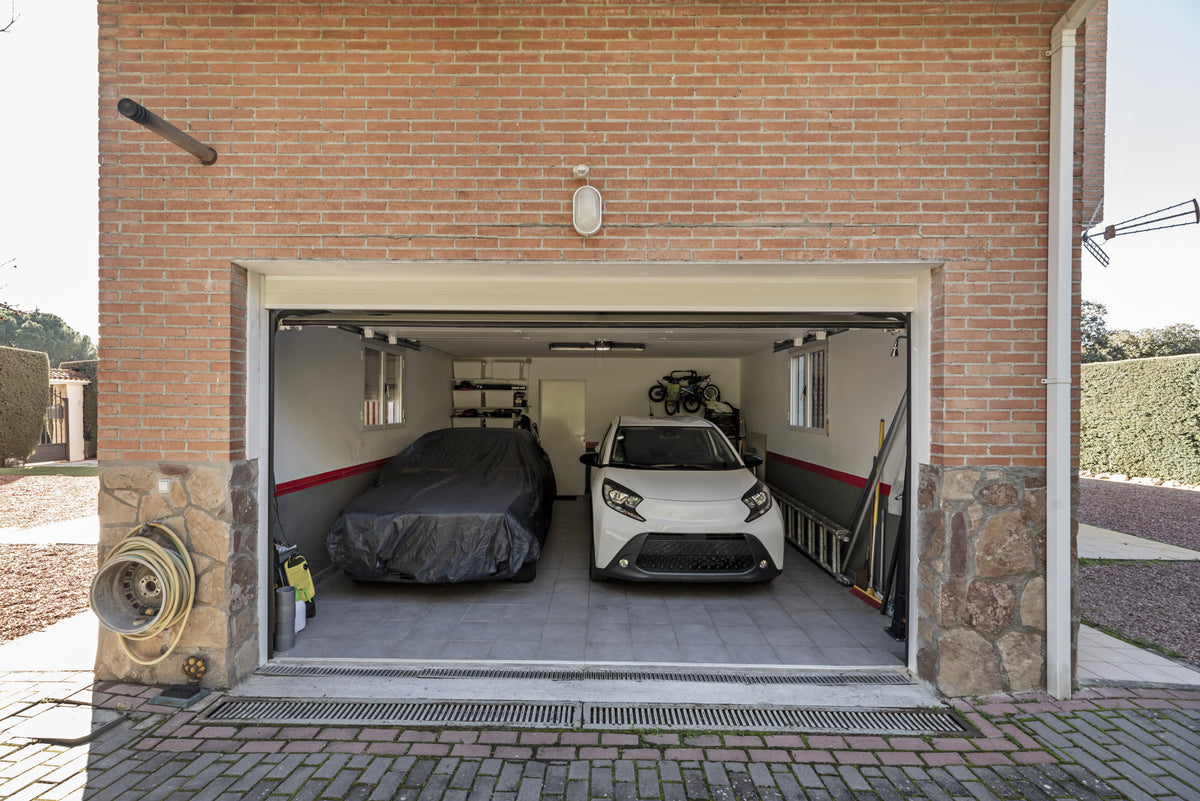
Yes. Most 2-car garages can take a car lift, and plenty of them can take one and still park two cars. The catch is that the answer depends on three measurements you can take today with a tape measure: ceiling height at the lowest obstruction, clear width, and clear depth. In a typical garage with an 8 ft ceiling, a low-profile 4-post or a mid-rise scissor lift fits and works. At 10 ft, a full 2-post or a storage 4-post opens up. At 11 ft or more, you can stack one car over another and get a third parking spot out of a two-bay garage.
This guide walks through each measurement, shows the real footprint of lifts we sell so you can lay them out on your own floor, covers the garage door problem nobody mentions until install day, and ends with three setups that work in real 2-car garages. Every lift dimension and price below comes from our own product listings this week.
Quick Navigation
- The Short Answer
- Five Measurements to Take First
- Ceiling Height: How High You Can Actually Lift
- Width and Depth: Can You Still Park Two Cars?
- The Garage Door Problem
- Which Lift Type Fits a 2-Car Garage
- Slab and Power Checks
- Three 2-Car Garage Setups That Work
- Our Top Picks
- Frequently Asked Questions
- Take the Next Step
The Short Answer
Most 2-car garages are built somewhere between 20 by 20 feet and 24 by 24 feet, with an 8 ft ceiling as the long-time standard and 9 to 10 ft ceilings common in newer homes. Here is what fits at each ceiling height.
| Ceiling height | What fits | What it is good for |
|---|---|---|
| 8 ft | Mid-rise scissor lift, or a low-profile 4-post with posts under 7 ft | Wheels, brakes, suspension, detailing. Not stacking cars, not standing upright under the car. |
| 9 ft | Most 4-posts, mid-rise scissors | Service at a comfortable crouch, oil changes, exhaust work on a low car. |
| 10 ft | Baseplate 2-posts (about 9 ft tall), all of the above | Full under-car access with wheels hanging free, as long as the car is not tall. |
| 11 ft and up | Storage 4-posts with a car parked underneath, full-height 2-posts | Parking three cars in two bays, or standing upright under most vehicles. |
Rule of thumb: width and depth rarely kill a lift in a 2-car garage. The ceiling decides which lift you buy, and the garage door decides how high you can actually use it.
Five Measurements to Take First
Before you look at a single lift, spend fifteen minutes with a tape measure and a step ladder. Write these five numbers down, because they are the same five we ask for on every fitment call.
- Ceiling height at the lowest point over the bay. Not the drywall in the middle of the room. Measure to the lowest thing over the spot where the lift will go: the garage door opener rail, the door track, a light fixture, a beam, or a pull-down attic ladder. That is your real ceiling.
- Clear width. Wall to wall at the narrowest point, then subtract anything that sticks out: a water heater, steps into the house, a workbench you are keeping, a freezer.
- Clear depth. From the inside face of the closed garage door to the back wall, again at the narrowest point. Steps and landings at the house door eat depth fast.
- Door opening and door hardware. Note the door height (7 ft is the common standard), the type of track, and where the opener is mounted. A single 16 ft wide door with a center-mounted opener is the most common 2-car setup.
- Slab and power. How thick the concrete is where the lift will sit, whether it is cracked, and what is in your electrical panel. You cannot see slab thickness from the surface; we cover how to find it below.
With those five numbers, the rest of this guide is just matching them to real lift dimensions.
Ceiling Height: How High You Can Actually Lift
Most buyers check one thing: will the lift fit under the ceiling? That is the wrong question. The posts are rarely the problem. The problem is the car on top of the lift, because the roof of the raised car is what hits the ceiling first.
The post height check
This is the easy part. The lift itself has to stand under your lowest obstruction with a little room to spare. Real numbers from our listings:
- Katool KT-4H850 (8,500 lb 4-post): 83.66 in. posts, with at least 88 in. (7 ft 4 in.) of ceiling recommended. This is the one that goes into an 8 ft garage.
- Katool KT-4H950 (9,500 lb storage 4-post): 97 in. posts, at least 102 in. (8 ft 6 in.) of ceiling recommended.
- Katool KT-4H110 (11,000 lb 4-post): 94.88 in. overall height.
- AMGO BP-9 (9,000 lb baseplate 2-post): 108 in. overall height, so roughly a 9 ft 6 in. ceiling once you leave room to work.
- Katool KT-H105 (10,000 lb 2-post): 110.9 in. overall height, with at least 116 in. (9 ft 8 in.) of ceiling recommended.
- Katool KT-X85 (8,000 lb mid-rise scissor): no posts at all. It sits 4.25 in. tall lowered and tops out at 40.15 in.
The usable lift height check
This is the number that decides whether the lift is useful. Use this formula:
Usable lift height = ceiling height minus vehicle height minus a safety margin.
We like at least 6 in. of margin between the roof and the lowest obstruction, more if you have roof rails or an antenna. Say you have an 8 ft (96 in.) ceiling and a sedan that measures 57 in. to the top of the roof. 96 minus 57 minus 6 leaves about 33 in. of lift height. That is mid-rise territory: enough to pull wheels, do brakes, and roll under on a creeper, but you are not standing up under that car.
Run the same sedan in a 10 ft (120 in.) garage and you get about 57 in. of lift height, which is a comfortable seated or stooped working height. At 12 ft you get about 81 in., and now a 6 ft person can stand under it. Measure your own vehicles before you trust any chart, including ours, because a pickup or a full-size SUV changes the answer a lot.
The stacking check
If the goal is parking one car over another, the formula is different:
Ceiling needed = bottom vehicle height + runway thickness + top vehicle height + safety margin.
The KT-4H850 runways sit 4.76 in. off the floor fully lowered, which is a fair stand-in for runway thickness on a home 4-post. Two 57 in. sedans with a 6 in. margin need about 125 in., or roughly 10 ft 5 in. Put a 70 in. SUV on top instead and you need about 138 in., roughly 11 ft 6 in. The lift also has to clear the bottom car: the KT-4H950 lists 76.5 in. of underneath clearance at its top lock, which covers most SUVs. A shorter 4-post like the KT-4H850, at 70.87 in. max lift height, has less room under the runways and suits a low car parked underneath rather than a truck.
Our full breakdown of ceiling math for two-posts lives in the ceiling height guide, and if your number came in under 10 ft, the low-ceiling lift roundup covers every short-height model worth a look.
Width and Depth: Can You Still Park Two Cars?
This is the question most 2-car garage owners actually care about. The lift goes in one bay. Does the other bay still work as a parking spot?
Width
A 20 ft wide garage gives you 240 in. wall to wall. Here is what each lift leaves behind:
- Katool KT-4H850: 107.95 in. overall width leaves about 132 in. (11 ft) for the second car.
- Katool KT-4H950: 112.7 in. overall width leaves about 127 in. (10 ft 7 in.).
- AMGO BP-9: 131.875 in. overall width leaves about 108 in. (9 ft).
- Katool KT-H105: 140.4 in. overall width leaves about 100 in. (8 ft 4 in.).
That last number is the reason we steer most 2-car garage owners toward a 4-post when they also need daily parking. A 2-post is wider than it looks, because the columns sit outside the car and the arms need room to swing. After a 2-post, the leftover bay is narrow for a modern SUV once you account for mirrors and doors that need to open. Measure your second car mirror to mirror, add room to open the driver door, and see whether it fits in what is left.
A 4-post wins the width fight for another reason: when it is lowered, you can park on it. The car you drive every day sits on the runways at ground level, and the bay still works as a bay.
Depth
Depth is where 20 ft garages get tight. A 20 ft deep garage gives you 240 in. from the door to the back wall.
- Katool KT-4H850: 198.43 in. long with ramps (16 ft 7 in.), leaving about 41 in.
- Katool KT-4H950: 214.96 in. with ramps (17 ft 11 in.), leaving about 25 in.
- Katool KT-4H110: 229.73 in. with ramps (about 19 ft 2 in.), leaving about 10 in. That is a 22 to 24 ft deep garage lift, not a 20 ft one.
Two-posts and scissor lifts use much less depth, since the car overhangs the lift. The KT-X85 scissor measures 83.5 in. by 76.75 in. overall when raised, so it fits in nearly any bay with room to walk around the car. If you are comparing the lift families side by side, our 2-post vs 4-post vs scissor guide covers what each one is good at beyond footprint.
READY TO SHOP?
Browse the full lift lineup at Pitstop Pro with overall width, column height, and power requirements published on every model, so you can check them against your own measurements before you order.
Browse all liftsThe Garage Door Problem
Here is the part that surprises people after the lift is already bolted together. On a standard residential door, the open door panels ride in horizontal tracks just under the ceiling, right over the front of each bay. The opener rail usually runs down the middle of the garage. When the door is open, the panels take up the same airspace your raised car wants.
That gives you three choices:
- Use the lift with the door closed. Free, and fine for many owners. Plan your work so the car goes up after the door comes down.
- Place the lift deeper in the bay. If you have the depth, moving the lift toward the back wall can put the raised car behind the door panels. A 24 ft deep garage makes this far easier than a 20 ft one.
- Convert to a high-lift door track. A high-lift conversion raises the track so the open door hugs the wall above the opening instead of running along the ceiling, and it often pairs with a wall-mounted opener to clear the center rail. Our high-lift garage door guide covers when it is worth it and what it involves.
Measure the door with it open. The lowest point of the open door and its track over your lift bay is the real ceiling for a raised car, and it is often a foot or more lower than the drywall.
The Automotive Lift Institute's lift buying guide makes the same point in plain terms: pay attention to the clearance you will have around and above the lift in the bay. Clearance problems are cheap to solve on paper and expensive to solve after delivery.
Which Lift Type Fits a 2-Car Garage
Every lift type can work in a 2-car garage. The question is which one matches your ceiling and what you want the lift to do.
4-post lifts: the default 2-car garage answer
A 4-post is the most forgiving lift for a home garage. You drive on, so there is no hunting for lift points. Most home 4-posts are free-standing, so they do not need anchors for normal use. You can park on it lowered, park under it raised, and many add a rolling bridge jack → later for wheel and brake work. The KT-4H850 and KT-4H950 both run on 110V or 220V, include a caster kit, drip trays, and a jack tray, and work with the Katool KT-RJ50 rolling jack ($959). Compare the full lineup in the 4-post lifts collection →
The trade-off: a 4-post covers the bottom of the car with runways, so suspension and brake work needs a bridge jack, and the footprint is long.
2-post lifts: best access, biggest ceiling ask
A 2-post lifts the car by its frame and leaves the wheels hanging, which is the best possible access for suspension, brakes, exhaust, and transmission work. It also has the smallest footprint front to back. In a 2-car garage the catches are height (around 9 ft to 9 ft 3 in. for the lift itself), width (11 to 11 ft 8 in. overall), and a thicker slab requirement. It is a great fit for a 2-car garage with a 10 ft or taller ceiling where one bay becomes the work bay and the other stays a parking bay. See every option in the 2-post lifts collection →
Mid-rise scissor lifts: the 8 ft ceiling answer
A mid-rise scissor like the Katool KT-X85 ($2,399) lifts 8,000 lb to 40.15 in., plugs into 110V, and can be used mobile or fixed. When it is lowered, it sits 4.25 in. off the floor and you can park right over it. If your ceiling is 8 ft and you mostly do wheels, brakes, and detailing, it is often the smartest lift in the building.
Portable 2-posts: for renters and shared garages
Portable column lifts like the Triumph C-7000 ($3,075) roll out of the way when you are done. They suit garages where the lift cannot be a permanent fixture. They still need a ceiling tall enough for the car you lift and a sound slab under the columns.
Slab and Power Checks
Ceiling, width, and depth decide which lift fits. The slab and the panel decide whether it is safe to install.
Concrete
Each lift lists its own minimum, and they are not the same:
- Katool KT-4H850 and KT-4H950: minimum about 4 in. (100 mm) at 3,000 PSI, level and uncracked. Free-standing, but the slab still has to meet that spec.
- Katool KT-H105: minimum 5.9 in. (150 mm) at 3,000 PSI, because a 2-post anchors into the slab and puts the load on a small footprint at each column.
- Katool KT-X85: minimum 6 in. listed on the product page.
Residential garage slabs are commonly poured around 4 in., which is why a 4-post is the safer default when you do not know what is under you. To find out, drill a small test hole where the lift will sit and measure, or check the build plans. Our 2-post concrete guide covers testing and what to do with a thin or cracked slab.
Power
Home 4-posts like the KT-4H850 and KT-4H950 run on 110V or 220V. Katool recommends a dedicated circuit with a 30 amp breaker and 10-gauge wire, and says a dedicated 20 amp circuit also works if the lift is the only thing on it. The KT-X85 is 110V. The KT-H105 needs 220V single-phase, which in many garages means an electrician and a new circuit. The electrical requirements guide covers breaker sizing and wiring.
Three 2-Car Garage Setups That Work
Here is how the numbers come together in the three garages we hear about most.
Setup 1: 20 by 20 ft, 8 ft ceiling
The most common garage and the tightest. A tall 4-post or any full 2-post is out on height. Two good answers:
- Katool KT-4H850 in one bay. The posts clear an 8 ft ceiling, it leaves about 11 ft of width and about 3 ft 5 in. of depth, and you park on it every day. With the door closed you can lift a sedan roughly 33 in. for wheel and brake work. It will not stack cars here.
- Katool KT-X85 scissor. Lowest footprint and lowest height. Park over it, lift to 40 in. when you need it, and keep both bays fully usable.
Setup 2: 22 to 24 ft deep, 10 ft ceiling
Now you have options. A baseplate 2-post like the AMGO BP-9 ($2,335) or the Katool KT-H105 ($1,899) clears the ceiling and turns one bay into a real work bay, provided the slab meets the anchor spec and you have 220V. The other bay stays for parking, though at about 8 ft 4 in. to 9 ft of leftover width, measure your second car first. If you would rather keep parking on the lift, a KT-4H950 fits on height and gives you about 57 in. of usable lift height for a 57 in. sedan.
Setup 3: 24 by 24 ft, 11 to 12 ft ceiling
This is the garage that gets a third parking spot. A storage 4-post like the KT-4H950 in one bay parks a car underneath and one on top, and the other bay stays open. Plan the stack with the formula above: two sedans need about 10 ft 5 in., an SUV on top of a sedan about 11 ft 6 in. With 24 ft of depth you can also push the lift back far enough to clear the door panels. For heavier trucks, the 11,000 lb KT-4H110 ($3,299) fits a 24 ft deep garage comfortably.
Planning the rest of the garage around the lift, from lighting to workbenches? The complete garage prep guide walks through every step before delivery.
Our Top Picks
Here are the standouts from this category, picked by our Lift Specialists for real-world fit and value.

Katool KT-4H850: 8,500 lb 4-Post (8 ft Ceiling Pick)
💳 Affirm & Shop Pay Installments at checkout | $2,699
The lift for the most common 2-car garage. 83.66 inch posts clear an 8 ft ceiling, it runs on 110V or 220V, and it is free-standing on a 4 inch, 3,000 PSI slab. At 107.95 inches wide it leaves about 11 ft for the second car, and you park on it every day.
Best for: 20 by 20 ft garages with an 8 ft ceiling that need both bays for parking.
View Pricing & Specs →★★★★★ Verified reviews · Authorized Katool dealer · Lift Specialists ready to help

Katool KT-4H950: 9,500 lb Storage 4-Post (Third Parking Spot Pick)
💳 Affirm & Shop Pay Installments at checkout | $2,999
The lift that turns two bays into three parking spots. 76.5 inches of underneath clearance clears most SUVs parked below, with 84.5 inches of max lift height. 97 inch posts, casters, ramps, drip trays, and a jack tray included, on 110V or 220V.
Best for: Garages with an 11 ft or taller ceiling and about 18 ft or more of clear depth.
View Pricing & Specs →★★★★★ Verified reviews · Authorized Katool dealer · Lift Specialists ready to help

Katool KT-H105: 10,000 lb 2-Post (Work Bay Pick)
💳 Affirm & Shop Pay Installments at checkout | $1,899
Full wheels-free access for suspension, brakes, and exhaust work. 110.9 inches tall and 140.4 inches wide, so plan on a ceiling of at least 116 inches, a 5.9 inch, 3,000 PSI slab, and a 220V circuit. One bay becomes the work bay, the other stays for parking.
Best for: 2-car garages with 10 ft or taller ceilings where one bay is dedicated to working on cars.
View Pricing & Specs →★★★★★ Verified reviews · Authorized Katool dealer · Lift Specialists ready to help
Frequently Asked Questions
Can you fit a car lift in a 2-car garage with an 8 ft ceiling?
Yes, with the right lift. A low-profile 4-post like the Katool KT-4H850, with 83.66 in. posts, or a mid-rise scissor lift fits under an 8 ft ceiling. You will get roughly 2 to 3 feet of lift height with a typical car on it, which covers wheels, brakes, and detailing, but not stacking cars or standing under the car.
How much ceiling height do you need to stack two cars on a lift?
Add the height of the bottom car, about 5 in. for the runway, the height of the top car, and at least 6 in. of margin. Two typical sedans need about 10 ft 5 in. of clear ceiling, and an SUV on top of a sedan needs about 11 ft 6 in. Measure to the lowest obstruction, including the open garage door.
Can you still park two cars in a 2-car garage with a lift?
Usually, yes. A 4-post lift lets you park on it when it is lowered, so both bays keep working, and a mid-rise scissor sits only about 4 in. tall so you can park over it. A 2-post takes about 11 ft or more of width, which can leave the second bay tight for a large SUV.
Is a 2-post or 4-post lift better for a 2-car garage?
For most 2-car garages, a 4-post is the better fit because it needs less ceiling, usually does not need anchors, and doubles as a parking spot. A 2-post is better when you have 10 ft or more of ceiling, a thick enough slab, and you mainly want full access to wheels and suspension.
Will my garage door hit the lift?
It can. On a standard track, the open door panels run along the ceiling over the front of each bay, so a raised car and an open door can occupy the same space. Lift with the door closed, set the lift deeper in the bay, or convert to a high-lift track.
Take the Next Step
The short version: almost any 2-car garage can take a lift. With an 8 ft ceiling, buy a low-profile 4-post or a mid-rise scissor. At 10 ft, a baseplate 2-post or a storage 4-post opens up. At 11 ft or more with enough depth, you can stack a car over another and park three cars in two bays. Measure to the lowest obstruction with the door open, check width and depth against the real footprint, and confirm your slab and panel before you order.
Send us your five measurements and we will tell you which lifts fit, including when the cheaper one is the right answer. Call or text our Lift Specialists at (470) 208-2754, or email support@pitstop-pro.com with your ceiling height, clear width and depth, slab thickness, and the cars you plan to lift.
Still Weighing Options?
Talk to a real human before you commit.
A lift that does not clear your ceiling or your garage door is an expensive mistake. We help home garage owners match a lift to their ceiling, slab, and cars every week. Five minutes on the phone with your measurements gets you a straight answer.
Get a Free Fitment Consult → Or call/text (470) 208-2754★★★★★ 700+ verified Pitstop Pro customers · No-obligation phone or email · Same-week freight on most SKUs
Keep Reading
Ready to buy?
Find the lift your garage can actually take
Send a Lift Specialist your ceiling height, clear bay width, slab thickness, and panel capacity. We will tell you which lifts fit, including when the cheaper one is the right answer.
Browse all liftsTalk to a Lift SpecialistLifetime customer support and a free fitment consult before you order. No sales tax in most states.
Leave a comment