

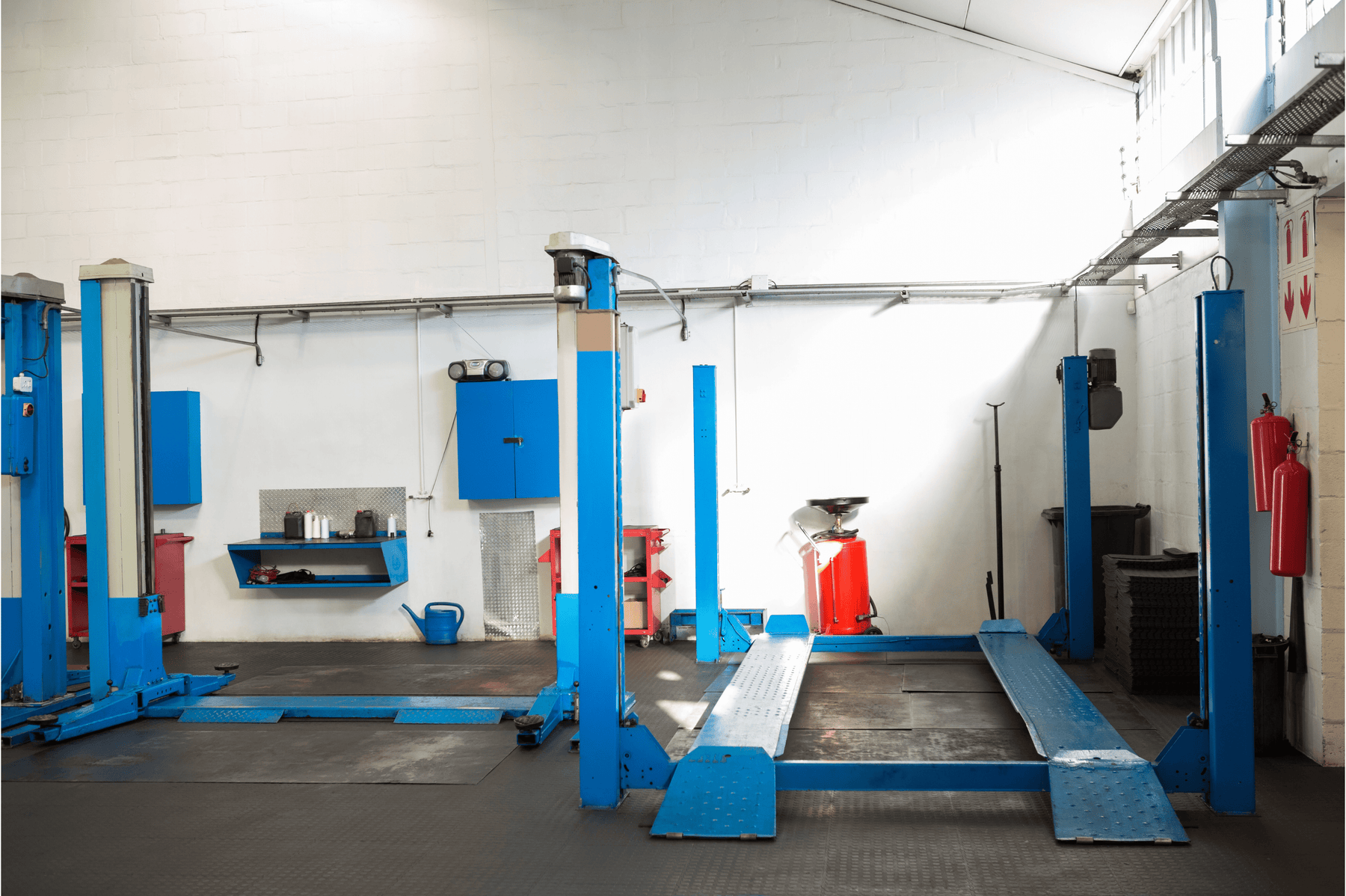
Bottom line: if you mostly turn wrenches (brakes, exhaust, suspension, full undercar work), a 2-post car lift is the right tool. If you mostly park, store, or run quick rolling jobs like alignments and oil changes, a 4-post wins. Both shapes lift the same vehicle; they just trade access for stability.
This guide is the straight 2 post lift vs 4 post lift comparison, written for home garages and small shops. You will see when each one earns its space, what they cost in floor area and ceiling height, and the two specific Pitstop Pro picks (one of each) that most of our customers actually buy. No filler, no hedging.
Quick Navigation

A two post vehicle lift uses two upright columns with adjustable arms that swing under the vehicle and contact the frame at the manufacturer-designated lift points. The wheels hang free, which is exactly what you want for brake service, suspension work, tire rotations, and pulling axles. Nothing on the floor blocks your line of sight to the underside.
Rule of thumb: if more than half of your time under the car involves removing wheels or working on the chassis, the 2-post earns its install. Browse the full 2-Post Car Lifts collection → if you want to see what fits your bay.
The trade-off: the operator does the work the lift cannot. Position the arms wrong and the car can shift on the pads, so every run starts with a careful arm setup and a check that the load is balanced front-to-back. Modern lifts have arm restraints, dual hydraulic synchronization, and automatic safety locks at multiple heights, but none of that replaces correct setup.
Installation is non-negotiable on slab. A 2-post needs a minimum of 4 inches of 3,000 PSI concrete (some columns spec 4.25 inches at 3,500 PSI), and ceiling clearance of roughly 11 to 12 feet for a standard 2-post and 12+ feet for a tall column. Skimp on either and you are looking at a re-pour or a different lift entirely.

A 4-post lift has four columns and two long runways. You drive the vehicle up the ramps and the tires sit on the runways the whole time the lift is in the air. Mechanical safety locks at every column engage at multiple heights, and the load is split four ways instead of two, so a 4-post feels stable in a way a 2-post simply does not, especially under heavier trucks and SUVs.
This is the lift built for 2 post car lift storage shoppers who actually need 4-post behavior: parking one vehicle above another, long-term storage of a project car, or quick on-and-off jobs like oil changes and alignments. Browse the 4-Post Car Lifts collection → if storage or stability is the lead use case.
4-post lifts also forgive the floor. Most freestanding models do not need to be bolted to slab; the four columns spread the load across a wide footprint and the lift sits flat without anchoring. That makes 4-posts the practical answer for thinner slabs, post-tension floors, or rental spaces where you cannot drill anchors. Optional caster kits let you roll the whole assembly aside when you need the bay back.
The catch: the wheels are pinned to the runways. For brake or suspension work you need a rolling bridge jack, which is an extra purchase ($600 to $1,200 typically) and an extra step in every job. And the floor footprint is real, expect roughly 9 ft x 18 ft of clear space for a typical 4-post.

READY TO BUY?
Browse all vehicle lifts at Pitstop Pro. 2-post, 4-post, scissor, and alignment options from top brands, with Lift Specialists ready to help you choose.
Shop vehicle liftsSame job, very different mechanics. Here is the side-by-side, structured how Pitstop customers actually compare them on the phone:
Vehicle support: 2-post lifts the chassis on two arms (wheels hang free). 4-post lifts the wheels on two runways (wheels stay loaded).
Stability: 4-post wins on raw stability and forgiveness for first-time users. 2-post is plenty stable when arms are positioned correctly, but the operator carries more responsibility.
Undercar access: 2-post is the clear winner for chassis, exhaust, brakes, and suspension. 4-post needs a bridge jack to free the wheels for those jobs.
Footprint: 2-post takes less floor space (typically 12 ft wide x 5 to 6 ft deep) but demands the right slab and ceiling. 4-post takes more floor space (roughly 9 ft x 18 ft for the runways) but tolerates lower ceilings and thinner slabs.
Installation: 2-post bolts into 4 inches of 3,000 PSI concrete minimum. 4-post is usually freestanding, no anchors needed.
Capacity: Most home-garage 2-posts run 9,000 to 10,000 lb. Most home-garage 4-posts run 8,000 to 14,000 lb. For full-size trucks and dually pickups, 4-post wins on capacity at the same price tier.
Storage use: 4-post is the only honest answer. Leaving a car on a 2-post long term puts continuous load on hydraulic seals and safety locks that were not designed for it.
Hard No's: never store a vehicle on a 2-post overnight, never use a lift below the rated capacity ceiling for the heaviest axle, and never skip the bolt torque check on a 2-post install. Each one of those is how lifts get pulled out of homeowners' garages with cracked baseplates and elongated anchor holes.
Two real picks from the Pitstop catalog, one in each shape, both under $3,500. These are the volume sellers our Lift Specialists put in front of home garage and small shop buyers more often than anything else.

AMGO BP-9: 9,000 lb 2-Post (Top 2-Post Pick)
💳 Affirm & Shop Pay Installments at checkout | $2,335
Best-selling 2-post lift for home garages. 9,000 lb capacity, symmetric design, single-point safety release. AMGO's volume seller with US parts support.
Best for: Home garages with 11-foot+ ceilings working on cars and light trucks.
View Pricing & Specs →★★★★★ Verified reviews · Authorized dealer · Lift Specialists ready to help

Katool KT-4H110: 11,000 lb 4-Post (Top 4-Post Pick)
💳 Affirm & Shop Pay Installments at checkout | $3,299
Best-value 4-post in the lineup. True 11K capacity, free-standing install, 181.9-inch runway, drip trays included. Built for full-size trucks and SUVs.
Best for: Storage and service garages needing real 11K capacity at a mid-budget price point.
View Pricing & Specs →★★★★★ Verified reviews · Authorized dealer · Lift Specialists ready to help
Decide on use case first, garage second. If your hours under the car go to brakes, exhaust, suspension, or anything that needs the wheels off, get the 2-post. If your hours go to parking, alignments, oil changes, or sharing one bay with two cars, get the 4-post. Trying to split the difference usually ends with the wrong tool for both jobs.
Then check the room. A 2-post needs the slab and the ceiling. A 4-post needs the floor area. If your slab is thin or your ceiling is short, the 4-post is often the only honest answer regardless of which one you would rather have. If your slab is good and your ceiling is tall, you have the freedom to pick on use case alone, which is the better problem to have.
One last thing on safety. Both lifts are safe when used correctly. Both have killed people when used incorrectly. Read the manual, follow the rated capacity, and respect the safety locks. We send a free fitment consult and the install checklist with every lift we ship. If you want a real human read on your specs before you commit, talk it through with our Lift Specialists at (470) 208-2754 or email support@pitstop-pro.com.
Ready to buy?
We carry the full vehicle lift lineup: 2-post, 4-post, scissor, and alignment models from Atlas, AMGO, Tuxedo, Triumph, Katool, and more. Talk to a Lift Specialist or browse the catalog.
Shop all liftsTalk to a Lift SpecialistLifetime customer support and a free fitment consult before you order. No sales tax outside GA & IL.
Leave a comment